
How to Identify and Resolve SEO Penalties: Practical Tips and Step-by-Step Solutions

Practical Tips to Avoid SEO Penalties on Your Website
Imagine your hard-earned website suddenly experiences a sharp drop in traffic, with search rankings for keywords vanishing overnight—this isn't a hacker attack, but likely your website has triggered a search engine's SEO penalty mechanism.
In the era of digital marketing, search engine optimization (SEO) is undoubtedly key to a website's success. However, many website managers, content marketers, and even SEO beginners often unintentionally cross the line due to unfamiliarity with search engines' constantly updated guidelines and algorithms. Once hit with an SEO penalty, not only does the website's visibility plummet, but it also directly impacts business growth and brand reputation, catching many off guard.
Don't worry, this is not an unsolvable dilemma. This article is your complete guide. We will take you step-by-step, in a professional yet friendly manner, to understand the causes and manifestations of SEO penalties. From detecting signs of penalties to establishing effective prevention strategies, we will provide practical tips and clear steps to help you avoid common pitfalls.
Whether you're a beginner just starting out or a website owner looking to solidify your site's foundation, this article will help you ensure your website's health and maintain a strong position in search results. Now, let's begin learning how to protect your website!
Understanding the Types and Causes of SEO Penalties
In the field of SEO, SEO penalties are one of the situations website operators least want to face. It refers to search engines (like Google) lowering a website's ranking in search results, or even removing it entirely, due to violations of their quality guidelines. Understanding the types of penalties and their root causes is the first step in effectively preventing and resolving issues.
The Difference Between Manual Penalties and Algorithmic Penalties
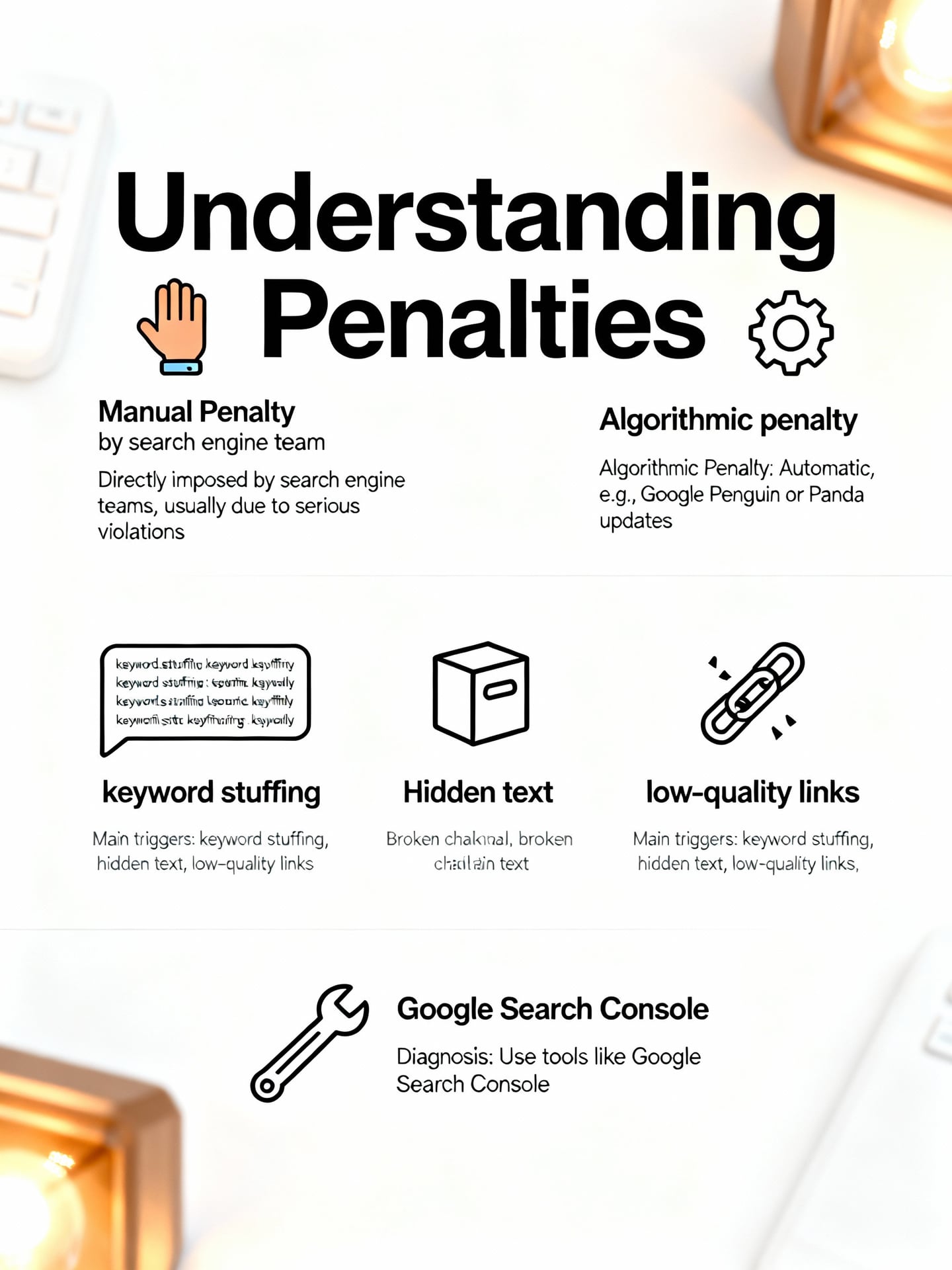
SEO penalties can be broadly divided into two main categories: manual penalties and algorithmic penalties.
- Manual Penalty: According to Google's official SEO Starter Guide, this is a penalty directly applied by the search engine's quality assessment team after a manual review. It typically occurs when a website has severe, intentional violations, such as large-scale spam links or cloaking techniques. Website administrators will receive a clear notification in Google Search Console.
- Algorithmic Penalty: This is an automated penalty mechanism. For example, Google's "Penguin" update primarily targets spam links, while the "Panda" update focuses on low-quality, duplicate, or thin content. According to the perspective of the renowned SEO tool Ahrefs, algorithmic penalties do not come with official notifications; their impact occurs automatically with algorithm updates.
My analysis is: For SEO beginners, the core distinction between these two lies in "whether there is a notification" and the "trigger mechanism." Manual penalties require a manual appeal to be lifted, while algorithmic penalties require improving website quality to recover rankings. I recommend website operators prioritize avoiding severe violations that could trigger manual penalties.
Common Behaviors That Trigger Penalties
Whether manual or algorithmic, penalties have clear triggering factors. Several major causes widely recognized in the industry include:
- Keyword Stuffing: Excessively repeating target keywords in an attempt to manipulate rankings. This violates the user-centric content principle.
- Hidden Text or Links: Setting text color to match the background, intending to deceive search engines. This is considered a serious black-hat SEO tactic.
- Low-Quality or Spam Links: This includes buying large quantities of links, participating in link farms, or having a large number of inbound links from unknown or irrelevant sources.
However, different experts have slightly different definitions of "low-quality links." For example, Moz's guidelines emphasize link relevance and authority, while Search Engine Journal focuses more on whether the link growth pattern is natural. From a practical standpoint, I believe website operators should adopt a "quality over quantity" mindset regarding links and regularly audit their backlink profile.
Quick Tip
A practical website diagnostic trick: Set up a custom alert in Google Analytics. When a website's organic search traffic drops abnormally by more than 20% in a single day, the system will automatically send an email notification. This can help you detect potential signs of an algorithmic penalty at the earliest moment and immediately initiate an inspection process.
How to Check if Your Website Has Been Penalized
If you suspect your website has received an SEO penalty, a systematic check is crucial. I recommend the following action steps:
- Primary Tool: Google Search Console: This is the official and most authoritative website diagnostic tool. Be sure to check the "Manual Actions" report daily to see if there are any manual penalty notifications. Also, observe whether there is a cliff-like drop in ranking and traffic data in the "Performance" report.
- Traffic Analysis Tools: Use Google Analytics to compare the timing of changes in organic search traffic with the dates of known major Google algorithm updates.
- Third-Party SEO Tools: Such as the site audit features of Semrush or Ahrefs, which can help detect technical violations (like numerous 404 errors, duplicate titles, etc.) and toxic backlinks.
Based on my experience, many small website operators neglect the daily check of Google Search Console. I strongly recommend setting it as a must-view daily dashboard; it is the most cost-effective and efficient early warning system.
In summary, understanding the difference between manual penalties and algorithmic penalties, recognizing common violations, and effectively using tools for website diagnostics are the three cornerstones of building a website's SEO resilience.
Content Quality and Technical Protection Measures

To effectively prevent SEO penalties, you must focus on both content quality and technical structure. According to Google's official guidelines, high-quality content is the cornerstone of avoiding penalties, while technical SEO is the key to ensuring your website can be correctly crawled and understood. From practical experience, many websites suffer SEO penalties precisely because they overlook one of these aspects. This section will provide specific protective measures to help you build a comprehensive defense system.
Steps to Create High-Quality Original Content
High-quality original content is the most direct line of defense against SEO penalties. Research from Moz indicates that original, in-depth content significantly reduces the risk of being flagged by algorithms. However, data from Ahrefs shows that many websites are still penalized due to duplicate or low-quality content.
My analysis is: the key lies in balance. I recommend you first conduct in-depth keyword research to understand genuine user needs, then naturally integrate keywords into your content, absolutely avoiding keyword stuffing. For example, when writing a "guide to SEO penalties," the focus should be on explaining the causes and solutions of penalties, not repeatedly mentioning the keyword. From a practical standpoint, I believe incorporating case studies or supporting data can greatly enhance the authority and uniqueness of your content, which is an effective strategy for preventing penalties.
Detailed Guide to Optimizing Website Technical Structure
Defects in technical structure can also lead to SEO penalties. Google's Page Experience update explicitly ties website speed to Core Web Vitals. Slow websites not only harm user experience but may also be demoted by algorithms.
Regarding this, there are two mainstream views in the industry: one emphasizes prioritizing server and cache optimization (as suggested by Cloudflare), while the other advocates starting with image compression and code minification (following Web.dev guidelines). I believe both are indispensable. In practice, I recommend you regularly use tools to check and fix broken links and duplicate content. If these technical issues accumulate, they can easily trigger SEO penalties. Furthermore, implementing structured data markup (like Schema.org) can help search engines understand your content more precisely. This is a proactive protective measure that can reduce the risk of misjudgment.
Practical Methods for Mobile-Friendliness
As mobile search becomes mainstream, mobile-friendly design is now a necessary condition for avoiding SEO penalties. Google's "mobile-first indexing" means the mobile version of your site will be the primary basis for ranking.
There are two common implementation methods: one is adopting responsive design (officially recommended by Google), and the other is building a separate mobile website. My experience is that for most websites, responsive design is easier to maintain and avoids issues of content inconsistency. The latter, if not handled properly, can ironically lead to SEO penalties due to duplicate content. I strongly recommend you ensure your website loads quickly and is easy to browse on various devices, and regularly conduct mobile compatibility testing.
Important Note
Critical Reminder: After 2025, Google has extremely low tolerance for large volumes of low-quality AI-generated content. When using AI to assist in content creation, it is essential to incorporate deep human editing, verification, and personal insights. Otherwise, it is highly likely to be flagged as spam by algorithms and incur SEO penalties. Always treat AI as a tool, not a complete substitute for content creation.
In summary, preventing SEO penalties requires dual protection from both content and technical aspects. High-quality original content is the core, while fast website speed, mobile-friendly design, and correct structured data form the solid technical backbone. Be sure to regularly review both areas to stay clear of penalty risks in the long term.
Link Building and Risk Management of External Factors

In the field of SEO, link building is crucial for enhancing a website's authority, but incorrect strategies can directly lead to SEO penalties. This section will explore how to safely manage external link factors to avoid triggering search engine penalty mechanisms due to poor-quality backlinks.
Strategies for Safely Building Backlinks
Regarding how to safely acquire backlinks, there are primarily two viewpoints in the industry. The first viewpoint (such as Google's official guidelines) emphasizes completely organic acquisition, advocating for creating high-value content that encourages other websites to link voluntarily. The second viewpoint (held by some practical SEO experts) believes that, while adhering to guidelines, moderate promotion is acceptable, for example, through guest posts or collaborations.
My analysis: Considering the risk of SEO penalties, I believe beginners should prioritize the first strategy. From a practical standpoint, I recommend you focus on creating in-depth content that solves user problems. This can naturally attract links from authoritative websites, significantly reducing the probability of penalties. Avoid participating in link farms or paid link schemes, as these black-hat techniques are explicitly penalized by Google.
Process for Monitoring and Cleaning Toxic Links
Regularly auditing your link profile is a necessary measure to prevent SEO penalties. According to data from tools like SEMrush, toxic links (e.g., from spam sites, link farms) directly harm a website's reputation. However, reports from Ahrefs indicate that not all low-quality links need to be addressed; their impact must be assessed.
From a practical perspective, I recommend you use Google Search Console or third-party tools monthly to check your link profile and identify toxic links. If a large number of spam links are discovered, you should immediately use Google's Disavow Tool to submit them for cleanup. This is a critical step in avoiding SEO penalties.
The Impact of Social Signals and Brand Mentions
Do social signals and brand mentions affect SEO penalties? One perspective (such as Moz research) suggests that social sharing can indirectly increase content visibility, attracting natural links. Another (such as Google's statements) emphasizes that social signals are not direct ranking factors, but brand mentions help build authority.
Based on experience, I believe building brand awareness to gain organic mentions can create natural linking opportunities, thereby reducing the risk of violating rules in the pursuit of links. I recommend beginners start with community interaction and gradually accumulate brand reputation; this is the safest long-term strategy.
Local Advantage
Local Expertise: 1waySEO has deep roots in the Taiwan and cross-strait markets, with a profound understanding of the search behaviors and localized content needs of the Traditional Chinese community. We can provide you with integrated SEO health check services that consider both the Google and Baidu ecosystems, offering a comprehensive analysis specifically for link building and external risks. This helps avoid triggering SEO penalties due to single-engine strategy failures or cultural differences, which could impact overall online visibility. Our localized professional team can assist you in developing link safety strategies tailored to the Taiwan and Chinese-language markets.
In summary, the core of managing link building and external factors lies in "quality over quantity" and "proactive monitoring." By naturally acquiring authoritative links, regularly cleaning toxic links, and building organic brand mentions, you can effectively construct a safe link ecosystem, staying far from the threat of SEO penalties.
Conclusion
In summary, SEO penalties are not unavoidable disasters but rather reminders that we must manage websites correctly and sustainably. This article started by understanding the types of penalties, emphasizing that high-quality, original content is fundamental, while a robust technical framework (such as mobile-friendliness and page speed) provides a solid foundation. Simultaneously, building natural, relevant, high-quality links and carefully managing external risks are essential for constructing a website trusted by search engines.
The key to avoiding penalties lies in "continuous monitoring and proactive optimization." This is a long-term process that combines content, technology, and link strategy, not a one-time task. As long as you maintain respect for search engine guidelines and focus on providing value to users, your website can stay clear of penalties and grow steadily.
Now is the perfect time to take action! We recommend you immediately review your own website, apply the practical tips mentioned in this article, and establish a habit of regular audits to flexibly adapt to search engine algorithm updates. Through these proactive measures, you will effectively protect your website and ensure its long-term health and success in search results.
Frequently Asked Questions
1. What is an SEO penalty? How does it affect my website?
An SEO penalty refers to actions taken by search engines (like Google) to lower a website's search ranking or remove it from their index due to violations of their quality guidelines. This typically stems from artificial ranking manipulation, low-quality content, or malicious technical practices. The impact is severe, including a significant drop in organic traffic, disappearance of keyword rankings, damage to brand reputation, and ultimately, business loss. Penalties can be triggered manually (via human review) or algorithmically (such as through Penguin or Panda updates).
2. How can I detect if my website has already been hit by an SEO penalty?
You can detect an SEO penalty through several key indicators. First, check the "Manual Actions" report in Google Search Console for any official notifications. Second, monitor if your website's organic search traffic has dropped sharply without reason in a short period (excluding seasonal factors). Use ranking tracking tools to see if rankings for your main keywords have collectively plummeted. Furthermore, if your website completely disappears from search results (a "site:yourdomain" search yields no results), this could be the most severe penalty. Regularly comparing algorithm update times with traffic changes is also an effective method.
3. In terms of content creation, what specific practices can help avoid triggering an SEO penalty?
The core of avoiding content-related penalties is adhering to a "user-centric" principle. First, eliminate any form of plagiarism or low-originality content, ensuring you provide unique value. Avoid keyword stuffing, letting keywords integrate naturally into the context. Content should have sufficient depth and completeness, genuinely solving user problems rather than being written solely for search engines. Simultaneously, establish a clear website structure and internal linking to help both users and search engines understand the content's context. Regularly updating and maintaining content, and removing outdated or low-quality pages, are also important preventive measures.
4. If my website is penalized due to low-quality or spammy backlinks, how can I effectively address and recover from it?
Addressing penalties caused by spammy links requires a systematic approach. First, use tools (like Ahrefs, Semrush) to conduct a comprehensive audit of your backlink profile, identifying toxic links (e.g., from link farms, irrelevant websites, links with heavily repeated anchor text). Next, attempt to contact the webmasters of these sites to politely request link removal. For links that cannot be removed, you must use the "Disavow Links Tool" in Google Search Console to submit a disavow file, clearly informing Google you do not want these links considered in their assessment. Upon completion, if it's a manual penalty, you can submit a reconsideration request with a detailed explanation of your cleanup efforts. The entire process requires patience and ongoing monitoring.
相關文章

SEO Practical Case Study Analysis: A Complete Training Guide from Zero to Mastery

Taiwan SEO Beginner's Guide: Practical Resources & Tools Map

SEO from Scratch: A Complete Guide for Beginners to Build Authority and Trust
