
How to Turn Keyword Rankings into Actual Conversions? Taiwan SEO Practical Strategy Analysis

How to Make Keyword Rankings Drive Actual Conversions?
Your website's keywords have climbed to the first page, but the traffic isn't converting into orders? This is a dilemma that excites yet perplexes many Taiwanese business owners and marketers. We invest countless hours and budgets to finally get our target keywords to the top of the Search Engine Results Page (SERP), so why do visitors who land on the site act like tourists at a scenic spot—just looking, not buying—and ultimately leave quietly?

In Taiwan's highly competitive digital marketing environment, we must face a reality: the era of simply chasing "keyword rankings" is over. Many business owners and SEO beginners often fall into the misconception that ranking equals results, overlooking the crucial link between search intent and user experience. The outcome is often impressive traffic numbers, but actual inquiries and orders are few and far between. This highlights the urgency of shifting from a "ranking mindset" to a "conversion mindset."
This article is written precisely to address this pain point of yours. We will set aside empty theories and directly guide you through systematically deconstructing the problem using localized, real-world data analysis, actionable AI tool integration suggestions, and fundamental mindset shift strategies. You will learn how to make the keyword rankings you worked so hard to achieve truly become the engine driving business growth, delivering quantifiable return on investment in the Taiwanese market. Ready to re-examine your SEO strategy? Let's begin.
Mindset Shift: Key Strategies from "Ranking-Oriented" to "Conversion-Oriented"
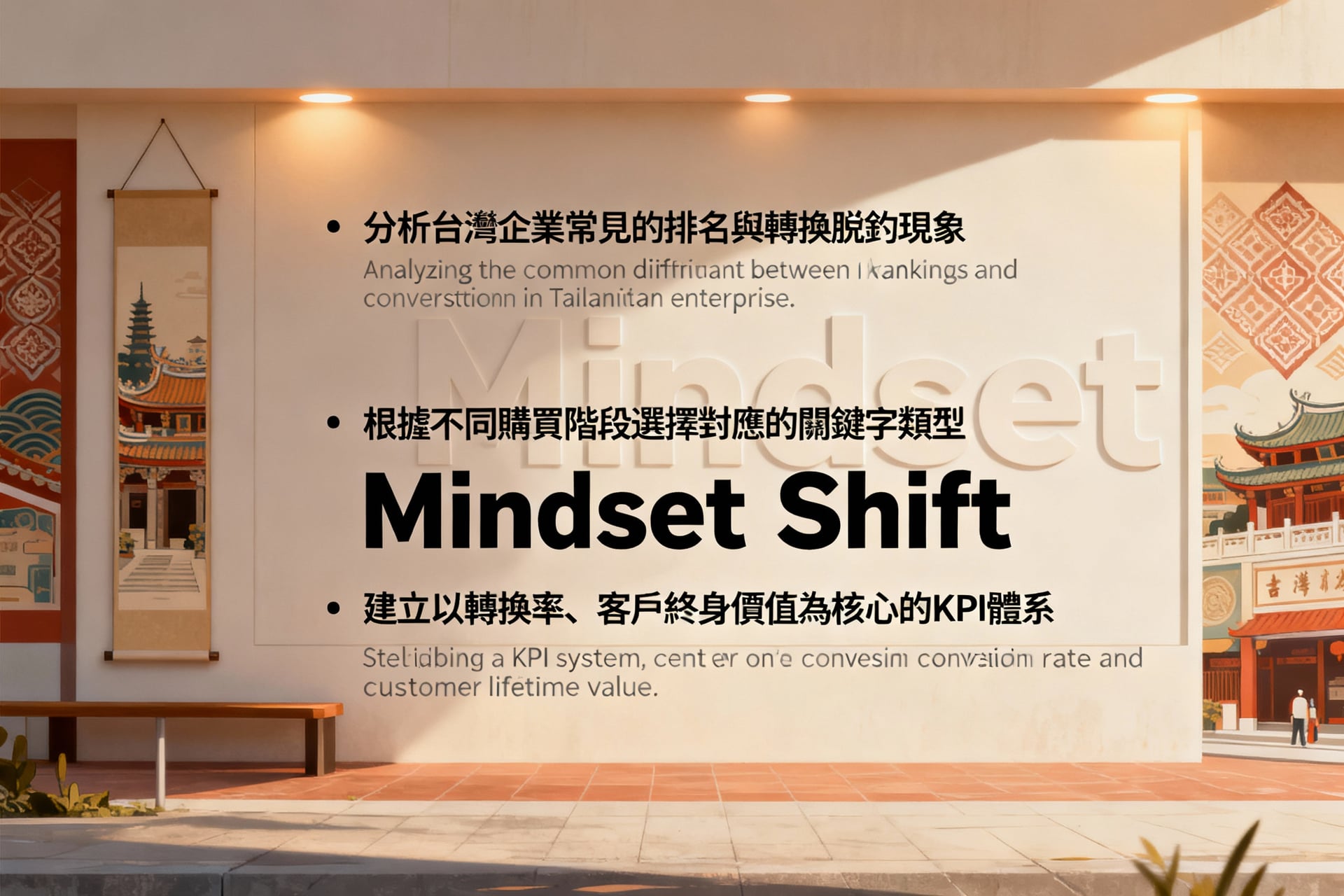
Many Taiwanese businesses invest significant resources in optimizing keyword rankings, only to find that traffic and orders are not proportional. This is precisely the moment to shift from a "ranking-oriented" to a "conversion-oriented" approach. This section will guide you in establishing a keyword ranking strategy centered on tangible business outcomes.
The Myth vs. Reality of Rankings in the Taiwanese Market
A common myth in the Taiwanese market is that "once keyword rankings reach the first page, orders will automatically follow." According to an SEO survey targeting Taiwanese SMEs, over 60% of respondents consider "first-page ranking" their primary KPI. However, another industry report released by a digital marketing agency indicates that a staggering 75% of websites, even with multiple keywords ranking #1, still have a conversion rate below 1%.
My analysis is that these two perspectives reveal the core issue. The former reflects businesses' traditional expectations of keyword rankings, while the latter points to the harsh reality. From a practical standpoint, I believe the root cause lies in the disconnect between keyword selection and user purchase intent. For SEO beginners, I recommend not just looking at ranking numbers, but also tracking the actual inquiries or sales generated by those keywords.
Aligning the Conversion Funnel with Keyword Intent
An effective keyword ranking strategy must be closely integrated with the consumer's purchase journey. According to the classic marketing funnel theory, keywords can be categorized as awareness, consideration, or decision-stage. For example, ranking for informational keywords like "what is AI" attracts traffic with vastly different value compared to ranking for commercial-intent keywords like "best AI copywriting tool recommendations."
However, some content marketing experts argue that broad informational keywords help build brand authority and can drive conversions in the long run. My view is that these two strategies are not mutually exclusive, but resource allocation must differ. For website operators with limited resources, I strongly recommend prioritizing the optimization of long-tail keywords with clear purchase intent (e.g., "[product name] Taiwan price comparison"). These directly correspond to the bottom of the conversion funnel, delivering immediate business value.
Redefining and Tracking Performance Metrics
The final step in the mindset shift is to redefine your performance metrics. Traditional keyword ranking reports (e.g., ranking position, search volume) should become secondary data. Core KPI setting should revolve around "conversion rate" and "customer lifetime value."
Important Note
The most common mistake made by many Taiwanese SME owners is allocating all SEO resources to "branded terms" or overly broad "head terms." These may bring traffic, but their conversion intent is extremely low. Please prioritize reviewing those long-tail keywords with clear commercial intent; they are the invisible engines driving orders.
The industry has two main approaches to this: one side believes in comprehensively tracking all micro-conversions from click to sale; the other believes that initially, focus should be on 1-2 core conversion goals (e.g., form submissions). Based on my experience, for teams just adopting a conversion mindset, I recommend the latter. First, define the single most important conversion action, analyze which keyword rankings brought in these high-value visitors, and then concentrate resources on optimizing those keywords. This is the most pragmatic way to start.
In summary, keyword ranking is an important starting point, but it is by no means the end goal. Shifting the mindset from chasing ranking numbers to analyzing the intent and commercial value of the traffic behind those rankings, and adjusting KPI setting accordingly, is the key for Taiwanese businesses to break through the competition.
Localization in Practice: Data Insights and Applications for the Taiwan Market
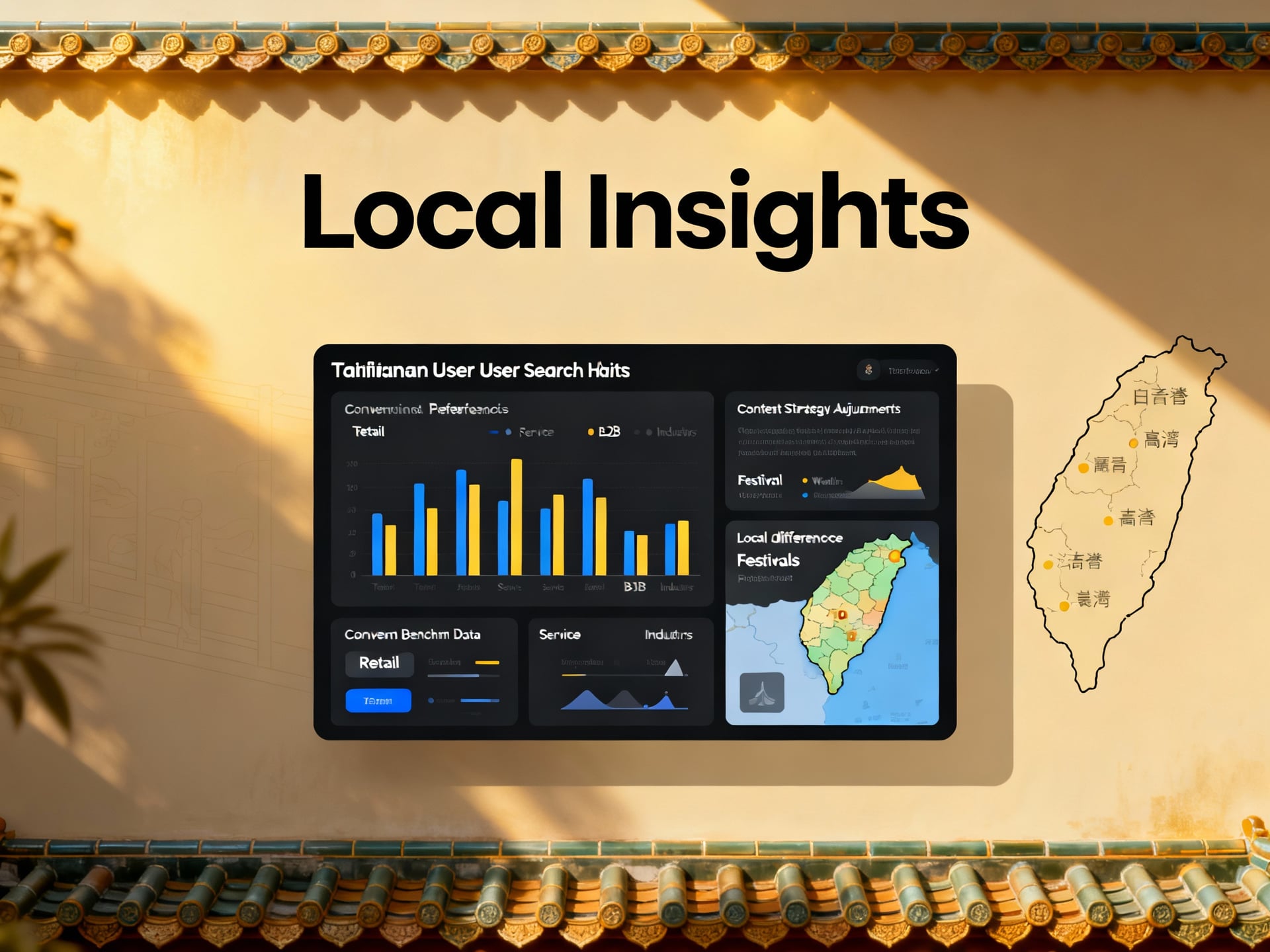
In the pursuit of keyword rankings, many Taiwanese businesses often overlook a core truth: ranking is just the process, conversion is the goal. To translate ranking advantages into actual orders, it is essential to deeply understand the uniqueness of the Taiwan market and apply these insights to keyword ranking strategies.
Analysis of Local Search Behavior and Cultural Factors
Analyzing the search habits of Taiwanese users is the first step in optimizing keyword rankings. According to a survey report on Taiwanese internet users, over 70% of users prioritize using the full Chinese name or localized nicknames when searching for products or services, rather than English or abbreviations. For example, searching for "手機維修" (phone repair) instead of "phone repair". However, another viewpoint from a social data analytics company points out that younger demographics (like Gen Z) are more likely to mix Chinese and English keywords or internet slang when searching for entertainment or trend information.
My analysis is: these two viewpoints seem contradictory but actually reveal that keyword ranking strategies must be segmented. For general consumer goods or services, consistently using the full Chinese names and colloquial terms common in Taiwan can more accurately match user intent and improve ranking relevance. For the youth market, it's necessary to monitor trending slang on forums like Dcard and PTT, and timely incorporate these "hot keywords" into long-tail keyword strategies. I recommend content marketers create a "local terminology glossary," update it regularly, and use it to optimize titles, body content, and meta descriptions.
Reference Benchmark Data for Industry-Specific Conversion Rates
With the right keywords, the next step is setting realistic conversion expectations. The benchmark conversion rates (Conversion Rate) driven by keyword rankings vary significantly across different industries. According to public data from several Taiwanese SEO consulting firms: the average conversion rate for retail e-commerce from a search engine results page (SERP) click is around 1%-3%; local service industries (like cleaning, plumbing) can be as high as 5%-8% due to more specific search intent; while the inquiry conversion rate for B2B industries is typically below 1%, but the customer lifetime value is high.
From a practical standpoint, simply comparing these industry benchmark data is not very meaningful. The key is understanding the underlying reasons: high-conversion keywords often correspond to "transactional intent" (e.g., "台北水管漏水急修" - urgent pipe leak repair in Taipei), while low conversion rates may correspond to "informational intent" (e.g., "SEO是什麼" - what is SEO). My suggestion is that businesses should first clarify the search intent of their target keywords, then compare against industry benchmarks to evaluate the return on investment (ROI) of keyword ranking efforts, and prioritize resources on keywords with high conversion potential.
Seasonal and Regional Adjustment Strategies
Taiwan's festivals, weather, and urban-rural differences directly affect search behavior and the competitiveness of keyword rankings. For example, search volume for keywords like "冷氣清洗" (air conditioner cleaning) in summer, "除濕機推薦" (dehumidifier recommendations) during the rainy season, and "年菜外帶" (New Year's feast takeout) during the Lunar New Year surges. Regionally, for the same keyword "咖啡廳" (café), Taipei users might often search for "安靜工作咖啡廳" (quiet café for work), while Tainan users might prefer "老宅風格咖啡廳" (old house style café).
Based on my experience, a successful regional strategy is dynamic. One viewpoint advocates planning and publishing relevant content a season in advance to capture early rankings for seasonal keywords. Another viewpoint emphasizes timeliness, leveraging weather forecasts or sudden events (like typhoons) to quickly produce relevant content and capture short-term traffic. I believe both should be implemented in parallel: conduct long-term content planning for predictable festivals (like the Mid-Autumn Festival); simultaneously, create content templates to enable quick adjustments and deployment during unexpected seasonal demand, ensuring the timeliness and relevance of keyword rankings.
Local Advantage
The Taiwan market possesses unique advantages for keyword ranking optimization. Compared to other markets, Taiwan has a high density of internet users, extremely active use of social platforms (like Facebook, LINE), and significantly higher public trust in local content and word-of-mouth. This means that leveraging discussion hotspots on local forums (like PTT, Dcard) or deeply observing users' actual pain points and questions in Facebook local groups can often uncover long-tail keywords with strong conversion intent yet relatively low competition, and provide valuable content inspiration. This makes your keyword ranking strategy more grounded and directly addresses the core needs of potential customers.
In summary, improving keyword rankings cannot focus solely on technology and backlinks. In the Taiwan market, it is essential to deeply integrate localized data, understand the cultural factors behind Taiwanese search behavior, reference industry benchmarks to set goals, and flexibly apply regional strategies. This way, top-ranking pages can truly become gateways to business performance.
Summary of this section: This section explored how to leverage local search behavior, industry conversion data, and seasonal/regional characteristics of the Taiwan market to develop more precise and effective keyword ranking and content strategies, transforming traffic into actual orders.
AI Tool Integration: Technical Applications to Boost Conversion Efficiency
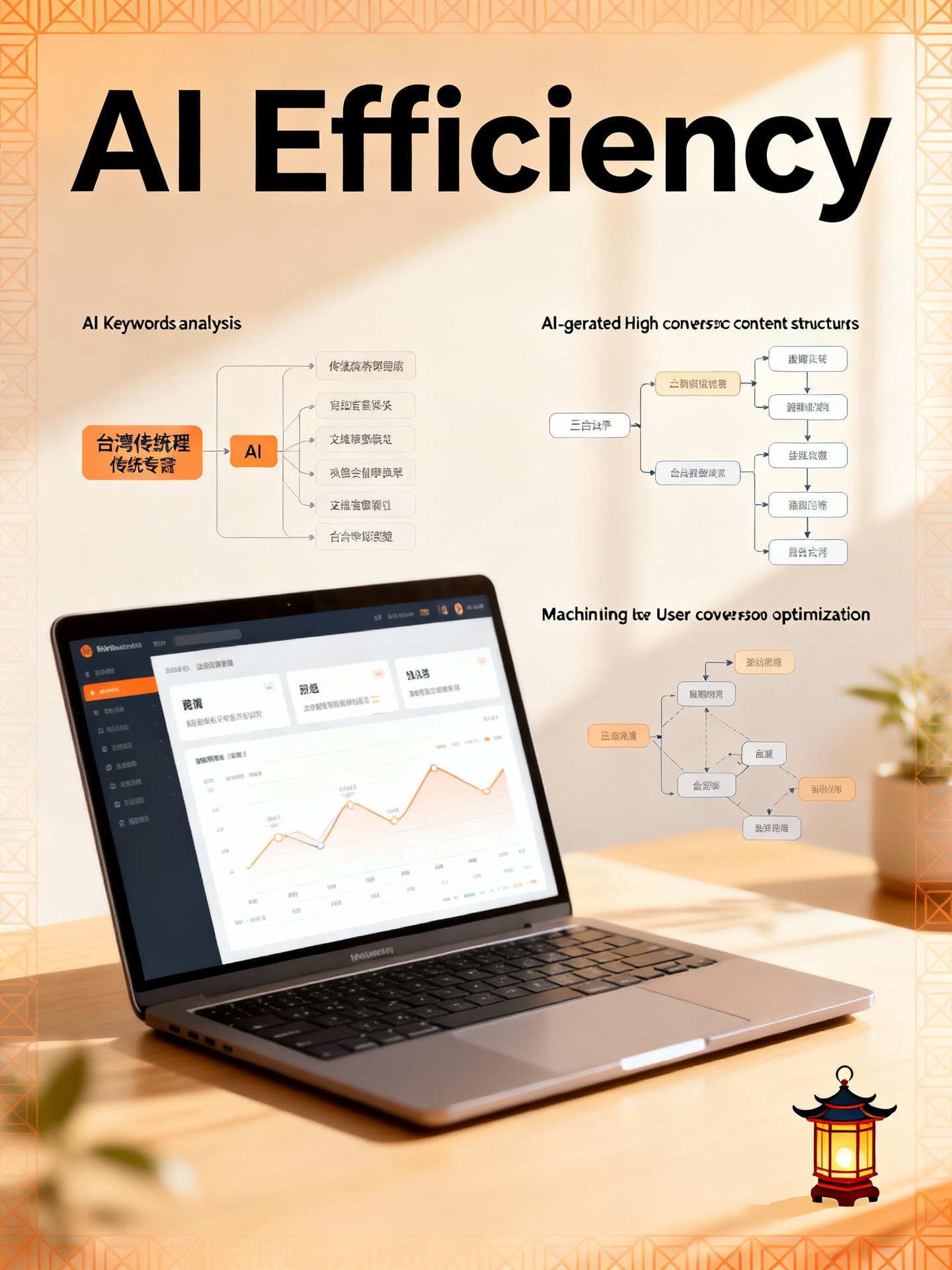
In the pursuit of keyword rankings, many Taiwanese businesses have found that even achieving a first-page ranking doesn't guarantee that traffic will convert into actual orders. This is the core challenge of the "conversion mindset": how to turn search traffic into commercial value? With the development of AI-powered SEO writing, integrating AI tools has become a key technology to solve this problem. This section will explore how to use AI, from keyword research to content optimization and conversion path prediction, to comprehensively improve conversion efficiency related to keyword rankings.
AI Keyword Research and Intent Analysis Tools
Traditional keyword ranking research might only focus on search volume and competition, but AI tools can delve deeper into analyzing user search intent. According to SEMrush's perspective, AI can use Natural Language Processing (NLP) to identify the commercial intent behind queries, such as "buy," "compare," or "tutorial." However, Ahrefs emphasizes that AI tools need to be combined with localized data to accurately predict trends in the Taiwanese market.
My analysis: Based on these two viewpoints, I believe that for SEO beginners and content marketers, priority should be given to AI tools that support Traditional Chinese and integrate Taiwanese search data, such as keyword analysis platforms developed locally in Taiwan. This ensures that keyword ranking strategies not only increase exposure but also target queries with high conversion potential. I recommend setting up a "conversion intent" filter within the tools to focus on keywords that can lead to inquiries or sales.
Quick Tip
Pro tip: When using AI tools, remember to explicitly include instructions in your prompt like 'targeting the Taiwanese market,' 'using Traditional Chinese,' and 'aiming to increase product inquiries or sales conversion rates.' This can significantly improve the relevance and practicality of the generated content, aligning your keyword ranking efforts directly with business goals.
Content Optimization and Personalization Recommendation Systems
After obtaining precise keywords, the next step is to use AI to generate content with high conversion potential. From a content optimization perspective, tools like Jasper or Copy.ai can automatically suggest article structures and headlines based on keyword ranking goals. On the other hand, personalized recommendation systems emphasize dynamically adjusting content, such as displaying different product information based on user behavior.
Based on experience, I've found that relying solely on AI-generated content may lack local sentiment, while excessive personalization can increase technical barriers. Therefore, for website managers, I recommend adopting a hybrid strategy: first, use AI tools to establish a content framework centered on keyword rankings, then manually incorporate Taiwanese cultural elements, and validate conversion effectiveness through simple A/B testing. This balances efficiency and authenticity, making traffic from keyword rankings easier to convert.
Conversion Path Prediction and Automated Adjustment
Finally, machine learning technology can predict and optimize user conversion paths. For example, Google Analytics' AI features can analyze which visitors from specific keyword rankings are most likely to complete a purchase and automatically adjust marketing resources. However, some experts warn that over-reliance on marketing automation might overlook the unique rhythms of the Taiwanese market, such as holiday consumption patterns.
My conclusion is: AI tools are indispensable for conversion optimization in keyword ranking efforts, but the key to success lies in "human-machine collaboration." From a practical standpoint, I recommend Taiwanese businesses start with AI keyword analysis, gradually expand to content and path optimization, and regularly review data to ensure every step is closely tied to the conversion goals of keyword rankings. This not only improves efficiency but also ensures ranking achievements truly translate into orders.
In summary, integrating AI tools is the modern solution for transforming keyword rankings into commercial value. Through precise research, optimized content, and path prediction, businesses can more effectively harness search traffic.
Conclusion
In summary, the ultimate value of keyword rankings lies not in the position itself, but in whether it can drive tangible conversions for your business. This article has broken down the core strategies from three major perspectives: First, the mindset must shift from "ranking-oriented" to "conversion-oriented," deeply understanding the intent behind user searches. Second, in the Taiwanese market, it is essential to combine localized data insights to create content that truly meets local needs. Finally, leveraging technological tools like AI can effectively enhance the efficiency of our optimization and analysis.
This is a systematic endeavor, but the starting point can be simple. Take action now: review your current keyword report, identify a keyword with "high ranking but low conversion," and use the conversion-oriented framework from this article to re-optimize its corresponding landing page or content. Be sure to set a one-month observation period to personally witness the changes in conversion rate data. This step will be the crucial beginning of upgrading your SEO from a traffic game to an engine for business growth.
Frequently Asked Questions
1. My website keyword is already ranking on the first page, so why isn't it generating orders or conversions?
This is a very common situation. It usually indicates that while your content matches the search intent, it fails to effectively guide visitors to take action. The key lies in examining the "search intent" and "content relevance": When a visitor searches for this keyword, are they looking to gather information, compare products, or are they ready to buy? Does your page content directly satisfy this intent and provide clear calls to action (CTAs) at appropriate points, such as inquiry forms, product trials, or purchase links? It is recommended to optimize the guidance and persuasiveness of your page content from the perspective of the user journey.
2. In the process of pursuing keyword rankings, how can I avoid creating content just for the sake of ranking while neglecting conversion goals?
This requires a shift in strategic thinking. It is recommended to define clear business objectives (e.g., lead generation, product sales) before planning content, and use these as the core for keyword selection. Don't just chase high-search-volume terms; pay more attention to keywords with "strong commercial intent" (e.g., "compare," "recommendation," "price," etc.). When writing content, every paragraph should consider how it serves this business goal, and naturally integrate solutions and action guidance into the content, allowing ranking traffic to flow smoothly towards conversion points.
3. For the Taiwan market, what localized data or strategies should be particularly noted when managing keyword rankings to improve conversion rates?
The Taiwan market has its unique characteristics. First, keywords need to consider local terminology and habits, for example, using "行動電源" (power bank) instead of "充電寶." Second, analyze the behavioral data of local consumers: When do they typically search and make purchases? What content formats do they prefer (text and images, videos)? What information are they most sensitive to (price, warranty, local service)? It is recommended to use tools like Google Analytics to analyze your website audience and combine insights from local forums and social media topics to create content that more closely addresses the pain points and needs of Taiwanese users. This way, the traffic brought by rankings will have greater conversion potential.
4. Are there any recommended AI tools or methods that can help me analyze which keyword rankings truly have the potential to bring conversions, rather than just ineffective traffic?
Yes, there are many AI tools available to assist with analysis. For example, you can use the advanced filtering features of keyword research tools (like Ahrefs, SEMrush) to filter out keywords with commercial intent. Additionally, content generation AI (like ChatGPT) can help you quickly analyze search intent and draft conversion-oriented content outlines. More importantly, use Google Search Console to analyze keywords that have already generated clicks, and observe which terms lead to visitors spending more time on your site and viewing more pages. These are signals of high-potential conversion keywords, and resources should be prioritized to optimize the corresponding landing pages.
相關文章

Review SEO Case Study Analysis: Complete Guide to Ranking Improvement for Taiwanese Websites

Practical Strategies to Improve Website Ranking: 3 Key Steps and Success Stories

Core Update Case Studies: How Businesses Successfully Adapt and Enhance Commercial Value
