
SEO Expert Shares: Practical Search Engine Optimization Strategies to Improve Website Rankings

SEO Expert Shares: Practical Strategies to Boost Website Rankings
Does your website consistently rank poorly in search results? Even after investing significant resources in search engine optimization, does your traffic remain stagnant? This is likely the biggest pain point for many business owners and website managers. However, the core issue may no longer lie in traditional technical adjustments, but rather in whether you've kept up with the fundamental shift in how search engines evaluate value.

In today's landscape of rampant AI-generated content and rapidly evolving algorithms, traditional search engine optimization strategies that rely solely on keyword stuffing or mass content publishing are becoming less effective. Google's algorithms are getting smarter, placing immense importance on a website's authority, trustworthiness, and expertise (the E-A-T principle), and have begun penalizing low-quality, non-useful AI content. This means that to achieve long-term, stable growth in website rankings, we must return to the fundamentals and master practical methods aligned with search engines' latest value systems.
Therefore, this article will break down two key strategies for boosting rankings in 2025 for SEO beginners, content marketing partners, and website managers. I will guide you in a professional yet approachable way to establish an actionable E-A-T Standard Operating Procedure (SOP) and share specific techniques for detecting and avoiding risks with AI-generated content. Let's work together to build a website that is both loved by users and trusted by search engines, truly standing out in the fierce competition.
Strategy 1: Establish a Complete E-A-T Implementation SOP to Strengthen Website Authority
In the field of search engine optimization, E-A-T (Expertise, Authoritativeness, Trustworthiness) has become a core concept that cannot be ignored. This section will delve into its importance and provide an actionable SOP process to help you effectively enhance your website's value in Google's eyes, thereby improving search engine optimization results.
The Core Concept and Importance of E-A-T
E-A-T is a core framework used by Google to assess the quality of webpage content, directly impacting search engine rankings. According to Google's official "Search Quality Evaluator Guidelines," E-A-T is considered a key metric for evaluating "Your Money or Your Life" (YMYL) topic pages. However, many third-party search engine optimization experts, such as Brian Dean from Backlinko, further point out that the principles of E-A-T actually apply to all websites aiming to build long-term online authority, not just those in the YMYL domain.
My analysis is: While the official guidelines emphasize its criticality for YMYL content, from a practical standpoint, any website hoping to gain stable traffic through search engine optimization should treat E-A-T as the cornerstone of its content strategy. It is not just a scoring factor for the algorithm but also the foundation for winning user trust. Therefore, I strongly recommend that all website operators, regardless of industry, systematically plan the construction of E-A-T.
Four-Step SOP for Concrete E-A-T Implementation
Establishing a clear SOP can give search engine optimization efforts more direction. Below is a four-step process I recommend after integrating various perspectives:
- Content Planning and Creation (Expertise): This step aims to showcase the website's professional knowledge. According to the Content Marketing Institute's recommendations, you should create in-depth, original content that solves user problems. However, hands-on SEO experts like Neil Patel emphasize building "topic authority," which involves creating a series of complementary content clusters around core keywords rather than isolated articles. I recommend beginners start with the latter approach: choose a niche topic to explore deeply and systematically produce content, which is more efficient than spreading efforts too thin.
- Enhance Website Authority Signals (Authoritativeness and Trustworthiness): This step is about proving "who you are" to Google and users. The key is transparency. Be sure to create detailed "About Us," "Author Bio" (including educational background, experience, and professional certifications), and clear "Contact" pages.
Quick Tip
Quick Start Advice for Small Businesses: When resources are limited, prioritize "Step 2" by perfecting your website's About Us, Author Bio, and Contact pages. Then, in "Step 3," proactively reach out to 1-2 local relevant media outlets or bloggers for collaboration. This can quickly establish foundational authority signals and lay a solid groundwork for subsequent search engine optimization efforts.
- Build High-Quality External Links (Authoritativeness): External links are seen as "votes of trust" on the web. Traditional SEO techniques emphasize acquiring links through guest posts, resource page links, etc. However, perspectives have evolved in recent years. For example, John Jantsch, author of "Duct Tape Marketing," advocates a "relationship-first" strategy, suggesting building genuine relationships with industry influencers first, then naturally collaborating on content and earning links. I believe that for content marketers, it's best to combine both views: consistently produce valuable content as "link bait" while actively engaging in digital PR to proactively build industry relationships.
- Optimize User Experience and Social Proof (Trustworthiness): This step concerns the user's final sense of trust in the website. It includes ensuring website security (HTTPS), fast loading speeds, easy navigation, and appropriately displaying social proof such as customer testimonials, case studies, or media coverage.
How to Measure the Effectiveness of E-A-T Implementation
E-A-T itself is not a direct metric in Google Search Console, but we can monitor it through related data. There are two main methods:
- Using Official Tools: Google Search Console is the primary tool. You can focus on changes in Click-Through Rate (CTR) and average ranking in the "Performance" report. Typically, improvements in E-A-T are accompanied by increased brand search volume, higher organic CTR, and enhanced ranking stability. Additionally, the "Coverage" report can help you monitor the indexing health and inclusion of your website's content.
- Leveraging Third-Party Tools: Many SEO tools provide indirect measurement dimensions. For example, you can use Ahrefs or Semrush to monitor changes in Domain Authority/Rating scores, the growth of high-quality backlinks, and trends in organic traffic. Also, metrics like Moz's "Page Authority" can serve as a reference.
From practical experience, I recommend using the "trend of organic traffic growth," "brand search volume," and "number of backlinks from high-authority websites" as the core triangle for measuring effectiveness. Fluctuations in a single metric can be influenced by various factors, but if all three show positive long-term synchronous development, it usually indicates that the website's E-A-T building is effective. Common mistakes to avoid include excessively pursuing link quantity over quality, or only updating content while neglecting to maintain authority signal pages like "About Us."
In summary, establishing an E-A-T SOP is a systematic project that requires simultaneous advancement on four fronts: content depth, website transparency, external recognition, and user trust. Through planned execution and monitoring, you can lay a solid foundation of authority for your website, which is an indispensable part of modern search engine optimization.
Strategy 2: Practical Techniques for Detecting and Avoiding AI Penalties
In the practice of search engine optimization, the proliferation of AI tools brings efficiency but also carries the risk of incurring search engine penalties due to poor content quality. This section will delve into how to effectively detect AI-generated content and formulate strategies to ensure your search engine optimization efforts are not counterproductive due to the misuse of AI.
Risks of AI-Generated Content and Penalty Mechanisms
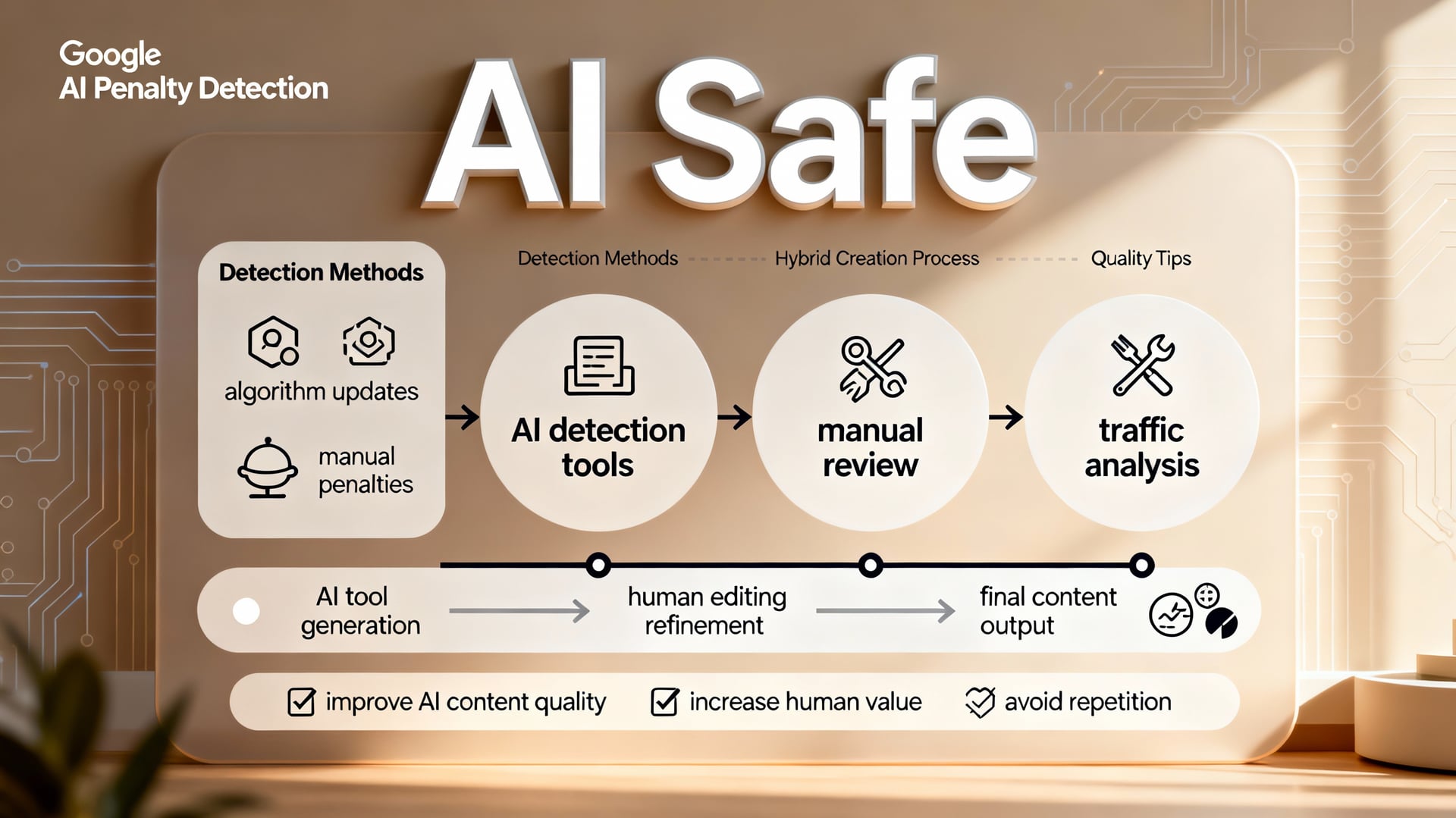
Google's approach to low-quality AI content primarily operates through two major mechanisms. According to official Google Search Central documentation, its algorithms (such as the "Helpful Content Update") automatically identify content lacking originality, depth, or authority and demote its ranking. On the other hand, if Google's quality raters discover a large amount of AI content that violates the Webmaster Guidelines, it may trigger a manual penalty, resulting in the removal of the website from search results.
However, the industry has different interpretations of this. Some search engine optimization experts believe Google is not "penalizing" AI itself, but rather any low-value content aimed at manipulating rankings, regardless of its source. Another viewpoint emphasizes that content purely generated by AI without human refinement is highly susceptible to being flagged by algorithms due to repetitive structure, unnatural tone, or factual errors.
My analysis is: the core issue lies in content quality, not the tool itself. Google's goal is to reward content useful to users. Therefore, the focus for search engine optimization practitioners should shift from "how to avoid being detected as AI-written" to "how to make content (whether AI-assisted or not) satisfy the E-A-T principles." I recommend beginners clearly distinguish: using AI to assist with research or drafting is feasible, but directly publishing its raw output is high-risk behavior.
Three Effective Methods for Detecting AI Content
Proactively detecting content before publication is a crucial part of search engine optimization risk management. Here are three practical methods:
- Use AI Detection Tools: Tools like Originality.ai and GPTZero can analyze the "AI probability" of text. However, please note that no tool can guarantee 100% accuracy; they should only be used as a reference for preliminary screening.
- Manual Review and Comparison: This is the most reliable method. Content marketers should carefully check factual accuracy, logical coherence, naturalness of tone, and compare the depth and perspective with high-ranking content in the industry. AI content often lacks unique insights or personal experience.
- Post-Publication Traffic Analysis: Monitor user behavior data after content publication, such as time on page and bounce rate. If a piece of AI-generated content that passed tool detection shows consistently poor engagement data, this in itself is a strong search engine optimization warning sign, indicating the content failed to meet user intent, indirectly leading to ranking issues.
From a practical standpoint, I recommend combining the first and third methods. Use tools to quickly filter out obvious issues, then rely on manual review to ensure core value, and finally use data to verify the content's actual performance.
Content Creation Strategies to Avoid Penalties
To fundamentally avoid AI penalties, the key is to establish a "human-machine collaboration" hybrid creation process and focus on improving content quality.
First, establish a hybrid creation process:
- AI-Assisted Ideation and Structure: Use AI to quickly generate topic outlines, keyword suggestions, or data organization.
- Core Content Written by Humans: Have the website owner or editor, based on professional knowledge, unique case studies, or firsthand experience, write the main body content with depth and authority. This is the key step to infuse E-A-T value.
- AI-Assisted Optimization and Expansion: Based on the human-written content, use AI again to check grammar, suggest more fluent expressions, or generate supplementary examples.
- Final Human Review and Publication: Have a human conduct a final fact-check, tone adjustment, and ensure the content perfectly aligns with search engine optimization goals (such as keyword placement, user intent).
Second, master specific techniques to improve quality:
- Add Human Value: Incorporate personal experience, exclusive data, industry interviews, or detailed step-by-step explanations into the content. This can significantly enhance the content's originality and authority.
- Avoid Repetitiveness: Carefully review AI-generated content, merge or rewrite sentences with repetitive meanings, and ensure each paragraph provides its own unique informational value.
- Optimize User Experience: Add clear subheadings, bulleted lists, images, or charts to make the content easier to read and understand, which directly benefits search engine optimization user engagement metrics.
Important Note
Critical Reminder: Never publish AI-generated content without any modification. Even if AI detection tools indicate "human creation," content lacking depth and value may still indirectly lead to ranking drops due to poor user engagement data (high bounce rate, low time on page). The real risk lies in the content's inability to solve user problems, not its production tool.
Summary
In summary, the key to effectively leveraging AI in search engine optimization is "assistance" not "replacement." By using effective detection methods to identify risks and adopting a hybrid creation strategy centered on human value, you can not only avoid search engine penalties but also produce high-quality content to gain a long-term competitive advantage. In the next section, we will explore how to integrate the above strategies into a complete E-A-T practical SOP.
Conclusion
In summary, to excel at search engine optimization in 2025, the core mindset must evolve from fragmented technical tactics to systematic trust-building and quality management. The two key strategies shared in this article—establishing a comprehensive E-A-T implementation SOP and mastering techniques to detect and avoid AI penalties—are precisely designed to address the search engines' increasing emphasis on "Expertise, Authoritativeness, and Trustworthiness." E-A-T is the cornerstone for gaining search engine trust, while high-quality, human-centric content is the safeguard against penalties from AI filtering mechanisms. These two aspects complement each other and are both indispensable.
The future of search engine optimization belongs to websites that can consistently demonstrate their value and expertise. Take action now: review whether your website meets E-A-T standards, and use tools to assess the AI risk of your existing content. We recommend establishing a quarterly review plan to systematically enhance authority and content quality, ensuring your website steadily improves its rankings and continues to grow amidst the ever-evolving algorithms.
Let this optimization journey begin today!
Frequently Asked Questions
1. What is Search Engine Optimization (SEO), and why is it important for my website?
Search Engine Optimization (SEO) is a comprehensive set of techniques and strategies aimed at improving a website's ranking and visibility in the organic search results of search engines like Google. It is crucial because the higher your website ranks, the easier it is for potential customers or readers to find you, thereby generating more free, valuable traffic. This not only boosts brand awareness but is also a fundamental cornerstone of digital marketing for acquiring targeted customers and achieving business goals (such as sales or lead generation). For beginners, understanding SEO is the first step toward effectively managing a website.
2. What is "E-A-T" mentioned in the article, and how does it help improve my website's ranking?
E-A-T is a core concept used by Google to assess page quality, standing for Expertise, Authoritativeness, and Trustworthiness. It is not a direct ranking factor but rather a quality guideline Google uses to determine if content is worth recommending to users. To strengthen E-A-T, you can create clear author bios showcasing professional backgrounds, cite reliable data sources, ensure website information (like contact details and privacy policies) is transparent and complete, and actively acquire high-quality backlinks from other authoritative websites. When your website excels in these areas, it is more likely to achieve better rankings in relevant searches because search engines will deem your content more trustworthy.
3. How should I start building a simple E-A-T Standard Operating Procedure (SOP) for my website?
You can begin building an E-A-T SOP with a few basic steps. First, review your "About Us" and "Author Bio" pages to ensure they clearly explain your team's professional qualifications and experience. Second, when creating content, always support your points by citing official data, research reports, or industry-recognized authoritative sources. Third, ensure your website has a secure HTTPS connection, a clear privacy policy, and contact information to establish basic trustworthiness. Finally, regularly review and update content for accuracy. You can turn these steps into a checklist to verify before publishing any new content, which can systematically enhance your website's overall authoritative image.
4. Will using AI tools to generate content get my site penalized by Google? What are some practical detection and avoidance techniques?
Google does not penalize the use of AI tools per se, but it explicitly opposes low-quality AI content created solely to manipulate rankings and lacking originality and value. The key lies in "how it's used." Practical techniques include: 1) Using AI as an辅助 tool for brainstorming outlines or polishing drafts, but ensuring core insights and analysis come from your own expertise. 2) Always performing in-depth manual editing before publishing, adding personal experience, unique case studies, or the latest data. 3) Using AI detection tools (like Originality.ai) for preliminary scans, but ultimately judging content based on the highest standard: "Does it provide genuine value to the user?" Remember, high-quality, human-centric content is always the foundation of good rankings.
5. As an SEO beginner, which part should I prioritize most when implementing these strategies?
For beginners, the top priorities should be "content value" and "basic technical health." Regarding content, focus on creating original articles that genuinely solve your target audience's problems, are informative, complete, and easy to read. This forms the foundation of E-A-T. On the technical side, ensure your website can be properly crawled and indexed by search engines. This includes checking and fixing 404 errors, improving page load speed, ensuring a good mobile browsing experience, and establishing a clear site structure (like breadcrumb navigation). By solidifying these two foundations first, and then gradually delving into advanced link building or AI-assisted strategies, your SEO journey will be more stable and effective.
相關文章

SEO Case Study: Master Search Engine Optimization Techniques to Boost Rankings

The Complete SEO Guide: Practical Strategies and Techniques from Beginner to Expert

SEO for Beginners: A Practical Guide and Key Steps to Get Started
