
SEO Fundamentals Guide: Master Core Techniques to Boost Rankings from Scratch

The Essential Guide to Mastering Core SEO Skills
Have you ever invested significant time and effort into optimizing your website content, only to find your search rankings stagnant or even ineffective? This is not an isolated case; many business owners, marketers, and website operators in Taiwan face the same challenge. The core of the problem often lies in failing to build the correct SEO foundation from the ground up, relying on outdated or one-sided techniques that lead to a disproportionate return on effort.

In today's digital age, Search Engine Optimization (SEO) is undoubtedly a key pathway for websites to acquire organic traffic. However, Google's algorithms are constantly evolving; the "shortcuts" that worked in the past may no longer be effective today and could even backfire. Without a solid core of SEO foundational knowledge, it's easy to get lost in the fiercely competitive search results pages, making it difficult for your target customers to find you.
Don't worry, that's precisely the purpose of this article. With a professional and friendly approach, we will systematically break down the true core of SEO fundamentals for SEO beginners, content marketers, and website operators. You will not only understand "what to do" but also grasp "why to do it" and "how to execute it effectively." We will provide clear steps, combined with case studies familiar to the Taiwanese market, to guide you in building an optimization strategy that can withstand algorithm changes, laying the most solid foundation for your website's rankings. Now, let's embark together on this journey of constructing your SEO foundation.
SEO Fundamentals and Core Principles
How Search Engines Work
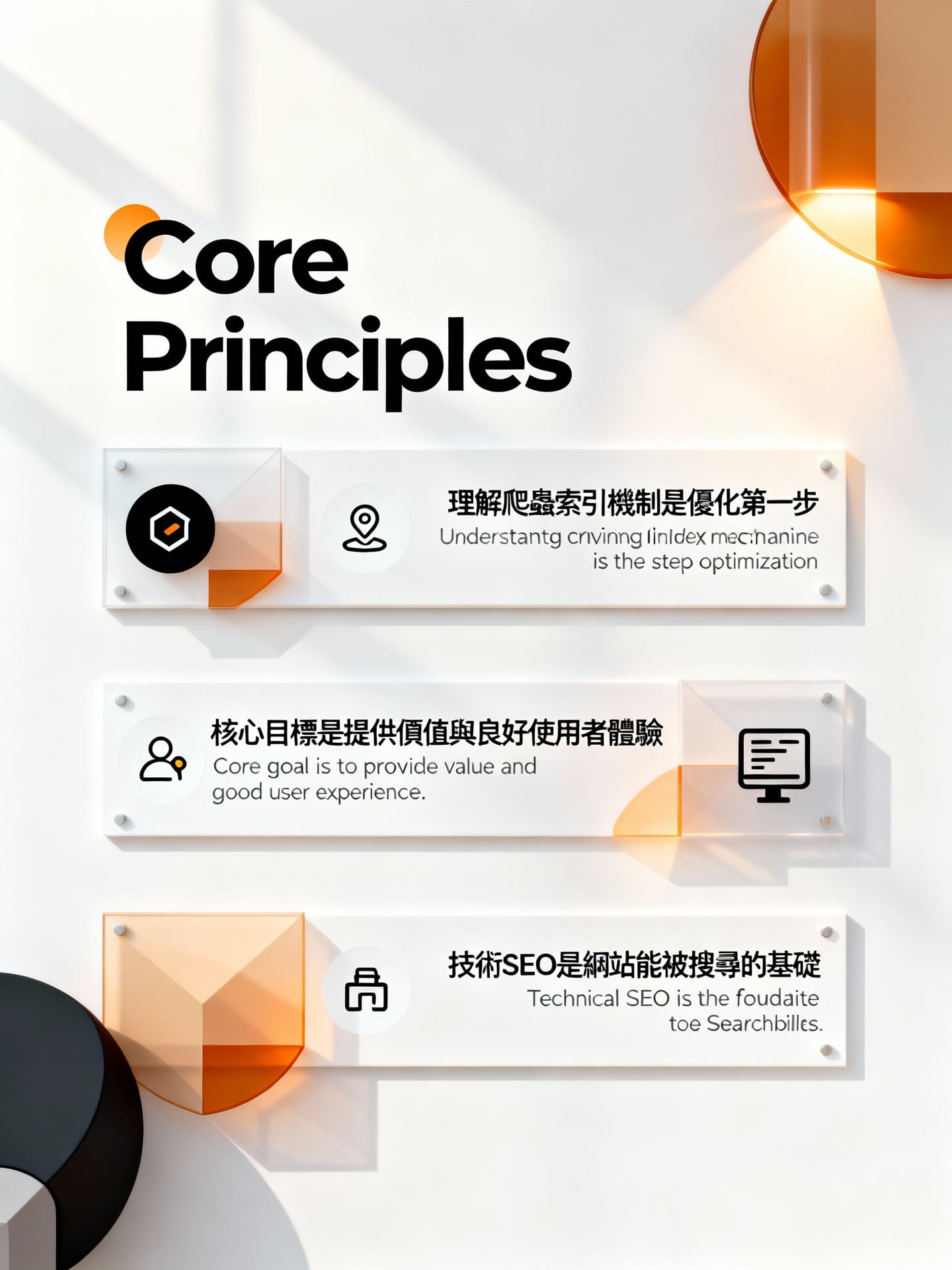
To grasp SEO fundamentals, one must first understand how search engines operate. According to Google's official documentation, search engines primarily process website content through three stages: "crawling," "indexing," and "ranking." However, senior SEO consultant John Mueller has emphasized that crawlers have limited resources, and the clarity of a website's structure directly impacts indexing efficiency. My analysis is: for SEO beginners, rather than delving into complex algorithms, it's more important to first ensure the website can be crawled and indexed smoothly. This is the prerequisite for all optimization work. I recommend you prioritize checking if the robots.txt file is correctly configured and ensure the website has a clear internal linking structure.
1waySEO Quick Tip
Actionable Tip: Take immediate action! Open Google Search Console and check the 'Coverage' report. This is the most direct way to understand your website's indexing status. You can see which pages have been indexed, which have errors, and make fixes accordingly. This is the first step in practicing technical SEO fundamentals.
The Core Goal of SEO
Regarding the core goal of SEO, there are mainly two perspectives in the industry: the traditional view considers SEO a game of "keyword ranking"; but the modern view, as revealed by search quality rater guidelines, emphasizes "providing value" and "good user experience." Based on my experience, these two actually complement each other—without a good experience, even acquired traffic is hard to convert; and without traffic, even the best content goes unseen. From a practical standpoint, I recommend website operators should focus on "solving user problems" as the core of content creation, while also paying attention to experience metrics like page loading speed and mobile-friendliness. This is a solid SEO fundamental strategy.
The Importance of Technical SEO
Technical SEO is often overlooked by beginners, but it is the foundation for a website to be searchable. Some content creators believe "as long as the content is good, technical details don't matter"; on the other hand, technical SEO experts point out that if a website cannot be read correctly by crawlers, even the highest quality content cannot participate in rankings. My conclusion is: technical SEO is like the foundation of a building. It doesn't directly bring traffic, but it determines the upper limit of website optimization. For website operators in Taiwan, I particularly recommend focusing on website speed (Taiwanese users are sensitive to speed) and structured data markup. These are fundamental techniques that can immediately improve search visibility.
In summary, understanding how search engines work, establishing a value-centric goal, and building a solid technical SEO foundation are three indispensable aspects of mastering SEO fundamentals.
Detailed Steps for Keyword Research and Content Optimization
Five Steps for Keyword Research
Keyword research is the core foundation of SEO, with the goal of finding the terms your target audience is actually searching for. Based on search intent, keywords can be categorized as navigational, informational, transactional, etc. I recommend beginners start with informational keywords, as this type of content is easier to establish authority with.
Step One: Start with Search Intent. According to Google's official guidelines, understanding "why" a user is searching is more important than "what" they are searching for. For example, a user searching for "SEO basics tutorial" intends to learn; while someone searching for "SEO service recommendations" might be ready to make a purchase. My analysis is: beginners should prioritize informational keywords, as this builds trust and lays the groundwork for future conversions.
Step Two: Use Tools to Expand Keywords. Industry-standard tools include Google Keyword Planner, Ahrefs, etc. However, some experts believe that relying solely on tool data can overlook context. I recommend combining tool data with observing actual search results, such as checking the "Related searches" section, which can reveal more natural keyword variations.
Step Three: Evaluate Competition and Search Volume. High-search-volume keywords are usually highly competitive. From a practical standpoint, for beginners, I recommend choosing "long-tail keywords," such as "what are some SEO basic techniques." Although search volume is lower, competition is smaller, intent is clearer, and it's easier to achieve rankings.
Step Four: Localization Adjustments. Especially for the Taiwan market, adding geographic modifiers can significantly improve targeting.
Step Five: Create a Keyword List. Categorize keywords and assign them to different content pages.
Local Advantage
When conducting keyword research in Taiwan, focusing on localized modifiers like "Taiwan," "Taipei," "recommendations," "how to," etc., offers significant advantages compared to globally generic keywords. For example, "SEO tutorial" is highly competitive, but "Taiwan SEO basics tutorial" or "Taipei SEO course recommendations" face less competition, have a more targeted audience, and yield higher conversion rates. This type of keyword helps beginners see results quickly in a less competitive environment and is an excellent entry point for building influence in the local market.
Content Structure Optimization Methods
Content optimization is another pillar of SEO basics. According to the Content Marketing Institute, quality content should solve user problems; while technical SEO experts emphasize the importance of structured data. My analysis is: both need to be combined.
I recommend building a "pyramid-style content structure": the top level is the core topic (e.g., "SEO Basics"), the middle level consists of subtopics (e.g., "Keyword Research," "Content Optimization"), and the bottom level provides answers to specific questions. This structure aids internal linking and boosts site authority. From a practical perspective, ensure each paragraph revolves around one keyword and uses H2, H3 tags for clear hierarchy, which helps search engines understand the content architecture.
Title and Description Writing Techniques
The title (Title) and meta description (Meta Description) directly impact click-through rates. According to A/B testing data, titles containing numbers or questions have higher click-through rates; but some content creators believe maintaining professionalism is more important. I think a balance is needed: titles must attract clicks while accurately reflecting the content.
Title Writing Suggestions: Include the primary keyword and place it within the first 60 characters. For example, "The Complete Guide to SEO Basics: 5 Steps to Teach You from Scratch" is more appealing than simply "SEO Basics Tutorial."
Description Writing Suggestions: The description should summarize the content and include a call to action. Based on my experience, keeping the description length between 150-160 characters is optimal, and naturally incorporate relevant keywords like "content optimization," "title optimization," etc.
In summary, keyword research and content optimization are the practical core of SEO basics. Starting from search intent, using localization strategies to reduce competition, and organizing content with a pyramid structure can effectively improve rankings.
This section introduced the detailed steps for keyword research and content optimization. Next, we will explore technical SEO basics, including website speed optimization and mobile compatibility, which are key to ensuring content can be properly crawled and indexed by search engines.
Link Building and Website Authority Enhancement Strategies

In SEO fundamentals, link building and website authority are among the core factors determining search rankings. According to Google's official guidelines, links are considered "votes" for a webpage, while website authority represents overall credibility. However, the industry holds different views on strategic priorities: some experts advocate prioritizing the establishment of an internal link structure, believing it is a completely controllable foundation; others emphasize that acquiring external links is the key to boosting authority. My analysis is that for SEO beginners, it's best to first solidify the internal linking foundation, then gradually expand to external links. Both aspects complement each other to steadily improve rankings.
Internal Link Optimization in Practice
Internal link optimization is the part of SEO fundamentals completely under the control of the website owner. According to content marketing experts, there are three key points to building a topic-relevant internal link network: first, naturally interlink related articles to help users and search engines understand the content structure; second, use descriptive anchor text instead of meaningless phrases like "click here"; finally, ensure important pages are reachable from the homepage within three clicks. From a practical standpoint, I recommend beginners start by establishing link hubs from the website's main service or product pages, then gradually expand to auxiliary content like blog posts.
Methods for Acquiring External Links
Acquiring external links is often seen as the most challenging aspect of SEO fundamentals. The traditional view suggests actively seeking link exchanges, but modern SEO experts generally oppose this practice, instead emphasizing the natural acquisition of external links through high-quality content. Based on experience shared within the Taiwanese SEO community, creating unique data, writing in-depth industry analyses, or developing practical tools are all effective methods for attracting natural links. I believe that for content marketers, rather than spending time sending out a large number of link request emails, it's better to focus on producing content that solves the pain points of the target audience, allowing links to be generated naturally.
Techniques for Establishing Authority Signals
Establishing professional authority signals is key to enhancing website trustworthiness. In SEO fundamental tutorials, the E-A-T (Expertise, Authoritativeness, Trustworthiness) principle is often mentioned. Different sources interpret this differently: the academic school emphasizes citing authoritative sources and expert testimonials; the practical school focuses on user experience and social proof. Based on experience, I recommend website owners adopt a comprehensive strategy: cite reliable sources in content, display professional certifications, encourage genuine user reviews, and ensure website information is complete and transparent. The accumulation of these signals can convey a strong authority message to search engines.
Important Notes
Note: Avoid using any black hat SEO tactics (such as buying links, keyword stuffing). This not only violates Google's guidelines, leading to penalties, but also damages brand reputation. SEO is a marathon, not a sprint. Adhering to white hat methods and focusing on providing value to users is the path to long-term success in SEO fundamentals.
In summary, link building and website authority enhancement require a two-pronged approach of internal optimization and external expansion. For SEO beginners, I recommend first mastering the internal link structure, then gradually attracting natural external links through high-quality content, while simultaneously establishing diverse authority signals.
Conclusion
Through the explanations in this guide, we have learned that mastering the fundamentals of SEO is not an overnight achievement, but rather a systematic process built from the ground up. Starting with an understanding of the core principles of how search engines operate, planning content direction through solid keyword research, and producing high-quality content that aligns with user intent are the foundations for attracting traffic. Simultaneously, we have also learned that technical SEO is the cornerstone ensuring a website can be properly crawled, while link building is a crucial strategy for enhancing a site's authority and solidifying its rankings.
Remember, SEO is a marathon, not a sprint. The key to success lies in "continuous optimization" — regularly reviewing data, adjusting strategies, and patiently accumulating results.
Now is the best time to start! Immediately assess your website's SEO status. Starting today, choose one or two core techniques mentioned in this guide to put into practice and consistently track the results. Step by step, you will steadily improve your website's visibility and ranking in search results.
Frequently Asked Questions
1. What are SEO fundamentals? Why is mastering this foundational knowledge so important for website owners?
SEO fundamentals refer to the core principles and introductory techniques of search engine optimization, including understanding how search engines work, keyword research, content optimization, technical SEO, and link building. For website owners, mastering these fundamentals is crucial because they form the foundation for increasing a website's organic traffic. Without a solid foundation, even advanced strategies are difficult to sustain. Starting with the basics ensures your website meets the core requirements of search engines, paves the way for subsequent optimization work, helps you gain a foothold in the competition, and effectively attracts your target audience.
2. As an SEO beginner, where should I start learning keyword research? What are some practical tools or methods suitable for the Taiwan market?
As a beginner, it's recommended to start by understanding "search intent." First, list topics related to your business, then use keyword tools to expand your list. In the Taiwan market, you can use the free Google Keyword Planner to get search volume data, or utilize tools like AnswerThePublic and Ubersuggest to find long-tail keywords. Additionally, observing competitor websites and popular discussion topics on local Taiwanese forums (like PTT, Dcard) is very helpful. The key is to find keywords with moderate search volume and low competition, and to ensure your content genuinely solves problems for Taiwanese users.
3. Regarding content optimization, besides including keywords, what other fundamental SEO techniques can improve an article's ranking in search results?
Beyond keyword placement, fundamental content optimization techniques include: writing click-worthy titles (containing the primary keyword), using clear subheadings (H2, H3) to structure content, and ensuring content depth and originality genuinely answer user questions. Furthermore, optimizing the meta description to improve click-through rate, naturally using related keywords (LSI keywords) within the content, adding internal links to guide traffic, and ensuring high content readability (e.g., using paragraphs, bulleted lists) are all crucial. Remember, content value and user experience are at the core of search engine evaluation.
4. For improving website authority, is link building part of SEO fundamentals? How should beginners safely start building backlinks?
Yes, link building is a key component of SEO fundamentals for improving website authority. For beginners, a safe approach should start with "quality over quantity": First, focus on creating high-value original content (like guides, case studies) that naturally attracts citations from other websites. Second, you can proactively engage in localized resource exchanges in Taiwan, such as collaborating with relevant bloggers for guest posts or sharing insights in professional communities (like Facebook groups). Avoid buying links or participating in link farms, as this can lead to penalties. Start by building a small number of high-quality, relevant backlinks to gradually increase your website's trust and ranking potential.
相關文章

SEO Case Study: Master Search Engine Optimization Techniques to Boost Rankings

The Complete SEO Guide: Practical Strategies and Techniques from Beginner to Expert

SEO for Beginners: A Practical Guide and Key Steps to Get Started
