
SPA SEO Implementation Guide: 3 Key Steps to Improve Website Search Rankings

Three Key Steps to Implement SPA SEO
Is your SPA website's traffic always stagnant? Even with powerful features and a smooth interface, does it remain unknown on search engines? This might be because you've overlooked the crucial implementation steps of SPA SEO.

As Single Page Applications (SPAs) built with frameworks like Vue and React become increasingly popular, developers and marketers often face a common dilemma: traditional search engine crawlers struggle to correctly parse content dynamically rendered by JavaScript, leading to website content not being effectively indexed and consistently failing to achieve ideal rankings in search results. Many teams invest significant resources in building high-quality SPAs, only to have their websites become virtually invisible due to SPA SEO issues, unable to reach a vast pool of potential users and customers.
Don't worry, there is a clear path to solving this technical challenge. This article will, in a professional yet approachable manner, break down the three key steps to implement SPA SEO for SEO beginners, content marketers, and website operators. We'll skip the complex theories and directly provide a combination of practical technical details and clear operational guidelines, leading you step-by-step from basic setup to advanced techniques to overcome SPA SEO obstacles. Regardless of the framework your project uses, you'll find specific methods to enhance your website's visibility and organic traffic.
Ready to ensure your SPA website is no longer ignored by search engines? Let's get started.
Step 1: Complete Server-Side Rendering (SSR) Setup
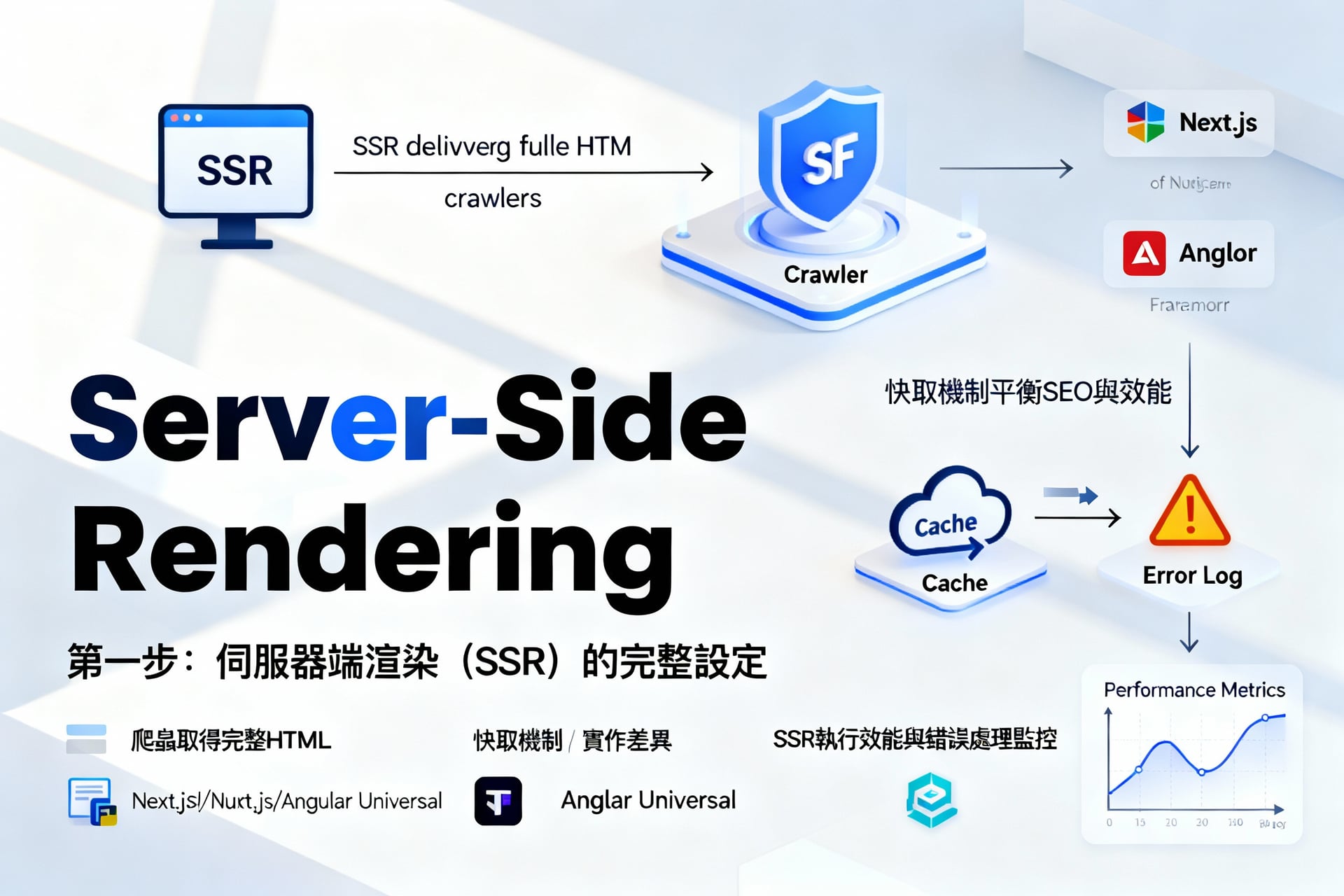
For any developer looking to improve their SPA SEO performance, Server-Side Rendering (SSR) is an essential, unavoidable technology. It directly addresses the core pain points of traditional Single Page Applications (SPAs) in search engine optimization.
The Basic Principle and Necessity of SSR
Traditional SPAs use Client-Side Rendering (CSR), where the browser receives an almost empty HTML skeleton, and the content is dynamically generated by JavaScript. This is great for user experience but poses a significant challenge for search engine crawlers. Crawlers may not wait for or execute JavaScript, leading to an inability to index the full content, severely impacting SPA SEO effectiveness.
The principle of Server-Side Rendering (SSR) is to pre-execute JavaScript on the server, generate the complete HTML content, and then send this "pre-rendered" page to the browser (or crawler). This way, both users and Google crawlers receive a fully content-rich page on the first request. According to Google's official documentation, this ensures crawlers can correctly interpret and index your website's content. However, some argue that as Google's crawler improves its ability to process JavaScript, the necessity of SSR might diminish. But from practical experience, SSR not only ensures indexing reliability but also significantly improves initial load speed, providing a double benefit for both user experience and SEO ranking.
SSR Implementation Solutions for Mainstream Frameworks
The three major frontend frameworks all have mature SSR solutions. Which one to choose depends on your tech stack and project requirements.
- Next.js (React Ecosystem): Widely considered the most seamless and complete solution for implementing SSR in React projects. It provides a page-based routing system and simple APIs, allowing developers to enjoy the benefits of SSR with almost no additional configuration. For beginners in SPA SEO, Next.js offers a relatively gentle learning curve.
- Nuxt.js (Vue Ecosystem): For Vue, it's what Next.js is for React. Nuxt.js offers a modular architecture and a "convention over configuration" philosophy, making SSR setup for Vue projects very intuitive. Its powerful module ecosystem also allows for easy integration of various SEO-related features.
- Angular Universal (Angular Ecosystem): This is the official server-side rendering solution for Angular. Its setup is relatively more complex than the previous two, requiring a deeper understanding of Angular's dependency injection and platform. However, its strength lies in deep integration with the Angular framework itself, making it suitable for large, complex enterprise-level applications.
My analysis is: For SPA SEO projects seeking a quick start, Next.js or Nuxt.js are better starting points; if a project is already based on Angular and the team is familiar with its ecosystem, then Angular Universal is a solid choice. The key is to choose a solution that the team can maintain consistently.
Performance Optimization and Caching Strategy
Implementing SSR is not a one-time fix. The server needs to execute rendering logic for each request, which increases computational load. Therefore, performance optimization and caching strategies are key to balancing SPA SEO effectiveness with website performance.
First, it's essential to monitor SSR execution performance and error handling. Use Application Performance Monitoring (APM) tools to track server response time (TTFB), ensuring the SSR process does not become a performance bottleneck.
Second, setting up appropriate caching mechanisms is crucial. Common strategies include:
- CDN Caching: Cache rendered static pages on CDN edge nodes. This is highly effective for content that doesn't change frequently (like blog articles) and can significantly reduce the load on the origin server.
- In-Memory Caching (e.g., Redis): Cache rendering results at the application layer, suitable for pages that require personalization but don't change frequently.
Based on practical experience, I recommend adopting a layered caching strategy. Use CDN caching for completely static pages; use in-memory caching for semi-static pages with reasonable expiration times; and carefully evaluate whether highly dynamic pages truly need SSR, or consider partial SSR (e.g., SSR only for critical metadata).
Important Note
Please be aware that SSR will significantly increase the computational load on your server, potentially leading to slower responses or even service interruptions during traffic spikes. You absolutely cannot just enable SSR and leave it unattended. It is imperative to implement the caching strategies mentioned above (like CDN caching, in-memory caching) in tandem, continuously monitor server CPU usage and response time (TTFB), and establish alert mechanisms. This is the technical cost that must be managed while reaping the benefits of SPA SEO.
In summary, a complete SSR setup is the solid first step towards excellent SPA SEO. It ensures content crawlability and indexability, laying the foundation for subsequent technical optimizations and content strategies.
Step 2: Precise Configuration of Dynamic Routing and Metadata

SEO Optimization for SPA Routing Structure
In SPA SEO, configuring dynamic routing is crucial. According to Google's official documentation, SPAs should use the History API to create clear, descriptive URL structures, such as /products/123, rather than messy hash fragments (#!). However, some tutorials for older SPA frameworks might still recommend using hash mode. My analysis is: based on the technological evolution of search engine crawlers, History mode has become the mainstream standard. It allows each "virtual page" to have a unique URL, which is vital for indexing. I recommend that when setting up Vue Router or React Router, you must choose History mode and ensure that route parameters correctly correspond to the content, for example, mapping a product ID to the corresponding product page title.
Dynamic Metadata Generation Techniques
Dynamically generating title, description, and canonical tags for different pages is core to improving SPA search rankings. According to Moz's SEO guidelines, each page should have a unique and keyword-rich title and description. However, the implementation methods of libraries like Vue Meta or React Helmet differ slightly: Vue Meta tends to use a declarative setup within components, while React Helmet is more flexible, allowing dynamic updates at any lifecycle stage. From a practical standpoint, both can achieve the goal. The key is to ensure that this metadata is updated instantly and correctly during user navigation, preventing search engines from crawling default or incorrect information. I recommend beginners start with the official documentation examples and explicitly set metadata for each route component.
1waySEO Reminder
Quick Tip: Use Google's Rich Results Test tool to verify if structured data is correct. This ensures your JSON-LD is parsed correctly, avoiding missed opportunities for rich snippets due to formatting errors. Local businesses in Taiwan can simultaneously optimize their Google Business Profile, taking a two-pronged approach to boost local search rankings, which is especially effective for SPA websites of physical stores.
Implementation Methods for Structured Data
Implementing JSON-LD structured data can significantly enhance the richness of search results (e.g., star ratings, price displays). Schema.org is the industry standard, but there are two mainstream viewpoints on implementation: one suggests embedding JSON-LD directly in the HTML, while the other advocates for dynamic injection via JavaScript. Based on my experience, the embedded method is more reliable, ensuring crawlers read it immediately; dynamic injection, while flexible, might cause crawlers to miss the data if executed too late. I strongly recommend using embedded JSON-LD for key pages like products, articles, and events, following Schema.org vocabulary. For example, annotate product pages with the Product type, including attributes like name, description, and offers. This directly helps Google understand the content and improves click-through rates.
In summary, the precise configuration of dynamic routing and metadata is the technical cornerstone for SPAs to overcome SEO limitations. Through standardized URLs, dynamically generated meta tags, and rich structured data, your Vue/React project will be more easily indexed and ranked by search engines.
Step 3: Advanced Applications of Pre-rendering and Hybrid Rendering
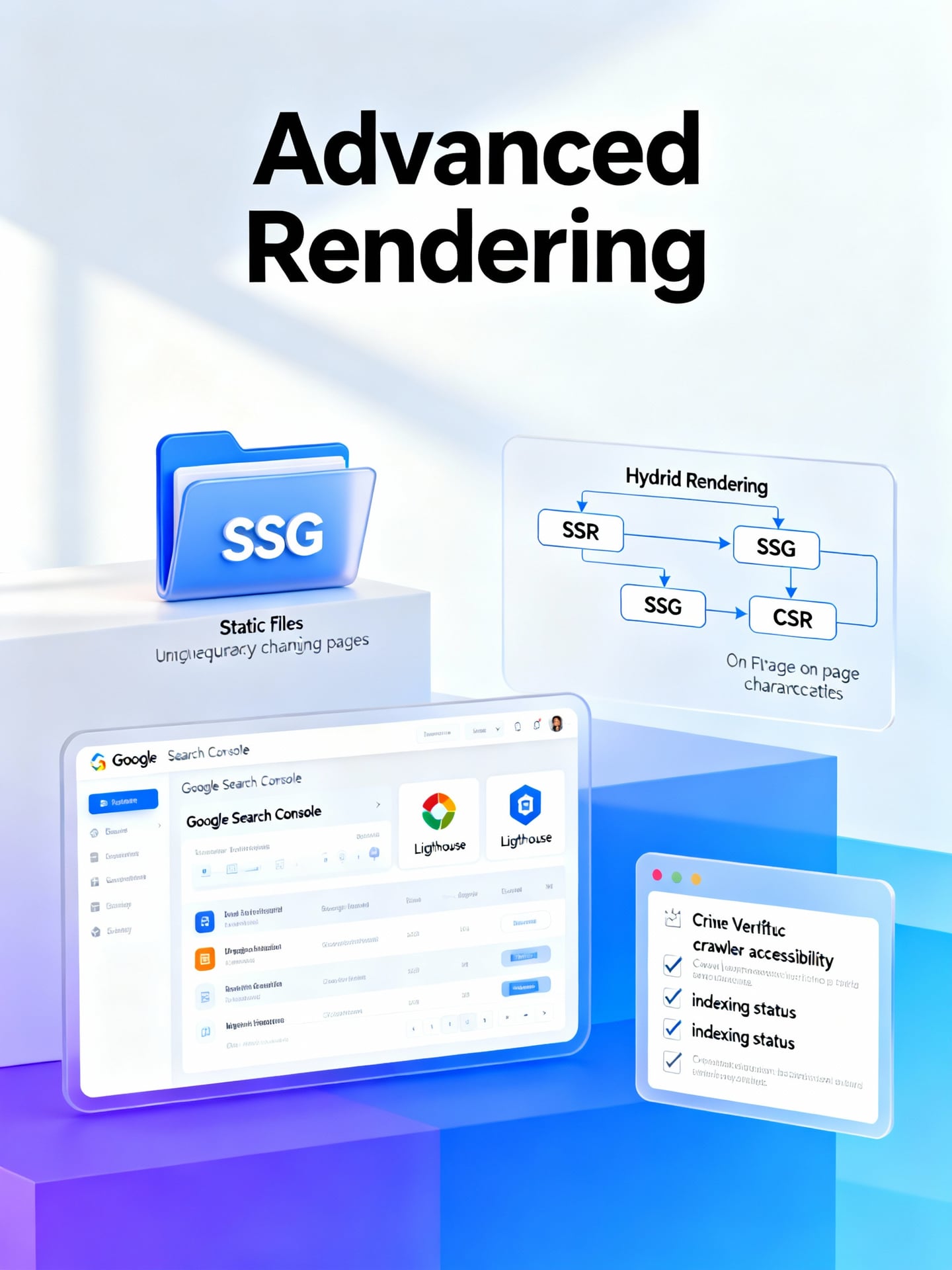
After mastering the basics of Server-Side Rendering (SSR), advanced SPA SEO strategies focus on the application of pre-rendering and hybrid rendering. This allows your website to not only be more search engine-friendly but also balance performance and development efficiency.
Suitable Scenarios for Static Site Generation (SSG)
Static Site Generation (SSG) is a form of pre-rendering that generates complete HTML files for pages during the website build process. According to Google's official technical guidelines, SSG is very suitable for pages with content that doesn't change frequently, such as product descriptions, company profiles, or blog articles. However, insights from the well-known SEO tool Ahrefs caution that pure SSG may not be suitable for pages requiring real-time updates (like inventory status, live pricing).
My analysis is: For most content-focused marketing pages, using SSG to pre-generate static files for infrequently changing pages is the optimal balance between performance and SEO. It provides extremely fast loading speeds, directly improving Core Web Vitals, which in turn affects Google rankings. I recommend that SEO beginners can start implementing SSG with pages like blogs or "About Us" sections.
Planning and Implementing Hybrid Rendering Strategies
No single rendering mode fits all pages, so choosing a hybrid approach of SSR, SSG, or CSR based on page characteristics is key. For example, the official documentation for the Next.js framework advocates the "hybrid rendering" concept, allowing developers to set different rendering strategies for different routes. On the other hand, Nuxt.js in the Vue ecosystem emphasizes a "universal rendering" foundation, supplemented by static generation as needed.
From a practical standpoint, I recommend content marketers collaborate with developers to plan: use SSG for high-SEO-value marketing landing pages; use Client-Side Rendering (CSR) for backends or dashboards requiring user login; and consider SSR for pages like product listings that need to balance real-time data with SEO. This hybrid strategy ensures the most important pages achieve optimal search visibility.
Local Advantages
Implementing these advanced technologies in Taiwan has its geographical advantages. Taiwan has a very active front-end technology community, such as "Vue.js Taiwan" and "ReactJS Taiwan." When you encounter technical bottlenecks implementing SSR or SSG, it's easy to find discussions and solutions within these communities. Furthermore, many local Taiwanese hosting providers and cloud platforms (such as Gandi and GCP Taiwan nodes) offer Node.js-friendly solutions suitable for deploying SSR/SSG applications, providing advantages in connection speed and technical support. This allows website operators to deploy advanced SEO architectures more smoothly.
Tools for Monitoring and Validating SEO Effectiveness
After setup, using tools like Google Search Console and Lighthouse to validate SEO settings is an absolutely necessary step. Google Search Console directly reflects your website's indexing status and search performance in Google's view, while Lighthouse can diagnose performance, SEO, accessibility, and other issues from a technical perspective.
However, the data provided by these tools needs correct interpretation. Some developers excessively pursue perfect Lighthouse scores while neglecting real user experience; conversely, some marketers only focus on click-through rates in Search Console without delving into the technical issues crawlers encounter. My recommendation is that website operators should develop a habit of regularly checking crawler accessibility and indexing status. For example, review the "Coverage" report in Search Console weekly and run a full Lighthouse audit monthly to compare differences over time. This is how you can continuously optimize.
In summary, advanced SPA SEO requires the flexible application of pre-rendering and hybrid rendering technologies, overcoming implementation challenges with local resources, and finally, using data tools for continuous tracking and validation to steadily improve your website's ranking in search results.
Section Summary: This section discussed the applicability of SSG, strategic planning for hybrid rendering, and emphasized the importance of using tools to monitor and validate SEO effectiveness, while highlighting the local advantages of Taiwan's technical community and hosting services.
Conclusion
In summary, implementing SPA SEO is not about applying a single technique, but rather a systematic strategy where each part is interconnected. From the foundational Server-Side Rendering (SSR), to ensuring each page's content is accurately understood through dynamic routing and metadata configuration, and then to the flexible balance of performance and indexing with pre-rendering and hybrid rendering—these three key steps together form the core architecture that allows SPAs to achieve both a smooth user experience and excellent search visibility.
For SEO beginners, marketers, and website operators, understanding and implementing these steps is precisely the key to fully unleashing the potential of modern front-end frameworks like Vue/React and converting it into tangible search rankings and traffic. This path is clear and feasible; by following these steps systematically, your SPA project can break the stereotype of being "unfriendly to search engines."
Take action now! Immediately review your SPA project and start planning and implementing these three steps today. Don't forget to use relevant tools to verify rendering results and metadata, and witness firsthand how your website's visibility in search engines gradually improves, ultimately standing out from the crowd.
Frequently Asked Questions
1. What is SPA SEO? Why do traditional Single Page Applications face difficulties with search engine optimization?
SPA SEO refers to search engine optimization for Single Page Applications (websites built with frameworks like Vue.js or React). Content in traditional SPAs is primarily generated dynamically by JavaScript, and search engine crawlers (like Googlebot) may not be able to fully index content when processing JavaScript. This can result in important page information, titles, or descriptions not being read correctly, thereby affecting the website's ranking and visibility in search results.
2. What are the specific benefits of implementing Server-Side Rendering (SSR) for SPA SEO? How does it work?
Server-Side Rendering (SSR) allows the website to pre-render pages into complete HTML on the server side before sending them to the browser or search engine crawler. This ensures crawlers can directly read the full content without waiting for JavaScript execution, significantly improving content indexability. In practice, you can easily integrate SSR using frameworks like Nuxt.js (for Vue) or Next.js (for React). These frameworks automatically handle routing and data prefetching, enabling each page to have unique titles, descriptions, and structured data, making it a crucial first step in improving SPA search rankings.
3. In an SPA, how do you correctly configure dynamic routing and metadata (such as title, description) for SEO?
In an SPA, you need to configure unique metadata for each dynamic route (e.g., product pages or blog posts). Implementation-wise, you can use Vue Router or React Router in conjunction with a backend API to dynamically set the <title>, <meta name="description">, and Open Graph tags when a page loads. It's recommended to use packages like Vue Meta or React Helmet for management and to ensure URL structures are clear and contain keywords. Additionally, generating a corresponding sitemap.xml for each route and submitting it to Google Search Console can help search engines discover and index your dynamic content more effectively.
4. Besides Server-Side Rendering, what other advanced techniques can further optimize SPA SEO performance?
In addition to SSR, you can also consider "Prerendering" and "Hybrid Rendering." Prerendering is suitable for pages with less frequent content changes; it generates static HTML during the build phase, reducing server load and offering extremely fast loading speeds. Hybrid rendering combines SSR with static generation, applying the most appropriate method for different routes. For example, use Nuxt.js's target: 'static' or Next.js's getStaticProps for prerendering, and handle pages requiring real-time data with getServerSideProps. These methods can balance performance and SEO requirements, allowing your SPA to enjoy both a fast user experience and excellent search visibility.
相關文章

Review SEO Case Study Analysis: Complete Guide to Ranking Improvement for Taiwanese Websites

How to Turn Keyword Rankings into Actual Conversions? Taiwan SEO Practical Strategy Analysis

Practical Strategies to Improve Website Ranking: 3 Key Steps and Success Stories
