
White Hat SEO in Practice: A Compliance Strategy Guide for Taiwanese SMEs with AI Assistance

Introduction

When you use generative AI to produce a week's worth of blog posts in just ten minutes, does a flicker of doubt cross your mind: Is this really safe? Could I wake up one day to find my website's rankings have plummeted to zero overnight?
With the widespread adoption of tools like ChatGPT and Claude, many small and medium-sized business owners and marketers in Taiwan have begun embracing AI, hoping to rapidly boost SEO visibility at an extremely low cost. However, search engine giant Google has repeatedly and clearly stated that it will take severe measures against low-value, non-original AI-generated content created solely to manipulate rankings. This article will delve into how to find the balance between "AI efficiency" and "SEO ethics," and provide compliant, practical strategies designed specifically for Taiwan's micro-budget businesses, ensuring your AI-assisted marketing is both fast and stable.
The Ethical Balance Between Generative AI and White-Hat SEO
Regarding the role of generative AI in SEO, there is a clear divergence of opinions within the industry. One camp, primarily the technical efficiency advocates, believes AI can break through the physical limitations of human production capacity, generating large volumes of content that comply with keyword specifications, making it an inevitable path for scalable SEO. The other camp, the cautious group centered on content quality and brand reputation, cites Google's Search Quality Evaluator Guidelines, emphasizing that content lacking "Experience" and "Expertise" ultimately harms both users and brands in the long run.
My Analysis: These two viewpoints actually point to the same core principle: AI is a tool, and the quality of a tool depends on the user's intent. Google's official statements have never "banned" AI content; rather, they target content that "abuses AI generation, intends to manipulate rankings, and provides no benefit to users." The key lies in how we use it.
Core Risks of AI Content Generation and Search Engine Guidelines
According to guidelines published by Google Search Central, their core framework for evaluating content—E-E-A-T (Experience, Expertise, Authoritativeness, Trustworthiness)—has become crucial. AI inherently lacks genuine "Experience" and "Expertise"; it can only synthesize existing information. Therefore, relying entirely on AI output often leads to content that remains superficial, lacking unique perspectives and empirical evidence, which is a primary reason for crossing search engine red lines. Experts point out that algorithms are increasingly capable of identifying the absence of "human insight" in content.
Demarcating the Line Between "Assisted Creation" and "Complete Outsourcing"
So, where should the line be drawn? I believe AI should be positioned as a "super research assistant" or a "first-draft generator." For example, it can help you quickly compile a list of common questions about "renovating old apartments in Taipei," but truly persuasive content must incorporate photos from cases you've actually handled, real plumbing and electrical issues encountered by clients, and localized experience from communicating with contractors. AI is responsible for expansion and structure; humans are responsible for infusing soul and verification.
Transparency and Value-Driven Content Strategy
There are currently no mandatory regulations on whether to label AI-generated content. However, from the perspective of building trust, I recommend that in fields involving professional advice, healthcare, finance, etc., it's appropriate to include a statement such as "This article was generated with AI assistance and has been reviewed and supplemented by [Your Brand/Expert Name]." This is not only a demonstration of transparency but also a declaration to users and search engines that the final quality gatekeeper is a "human" with professional knowledge.
Specific Action Recommendations:
- Establish an AI Content Compliance Checklist: Does the content have a unique perspective? Does it supplement real-world cases or data that AI cannot provide? Are the headlines overly exaggerated?
- Insist on the "Human Last Mile": All AI-generated content must be localized and polished by an editor or business owner familiar with the Taiwanese market, incorporating Taiwanese Hokkien terms, local cultural references, or genuine insights.
- Value Self-Questioning: If all keywords were removed, would this article still have reading value for the target audience in Taiwan?
Practical White-Hat SEO for Taiwan's SMEs on a Micro-Budget
For small and medium-sized enterprises (SMEs) in Taiwan with monthly marketing budgets potentially ranging from just a few thousand to tens of thousands of New Taiwan Dollars, resource allocation is the biggest challenge. Two common viewpoints exist in the industry: one advocates putting the entire limited budget into high-frequency publishing to win by volume; the other suggests concentrating resources to create a few "cornerstone" pieces of in-depth content.
My Analysis: With the assistance of AI tools, we no longer have to make this binary choice. The core of a micro-budget strategy should be a "hybrid model": use AI to enhance research and drafting efficiency, allowing humans to focus on investing resources into the key content that best builds authority, and then intelligently repurposing and disseminating it.
Low-Cost, High-Impact AI Tool Combinations and Workflows
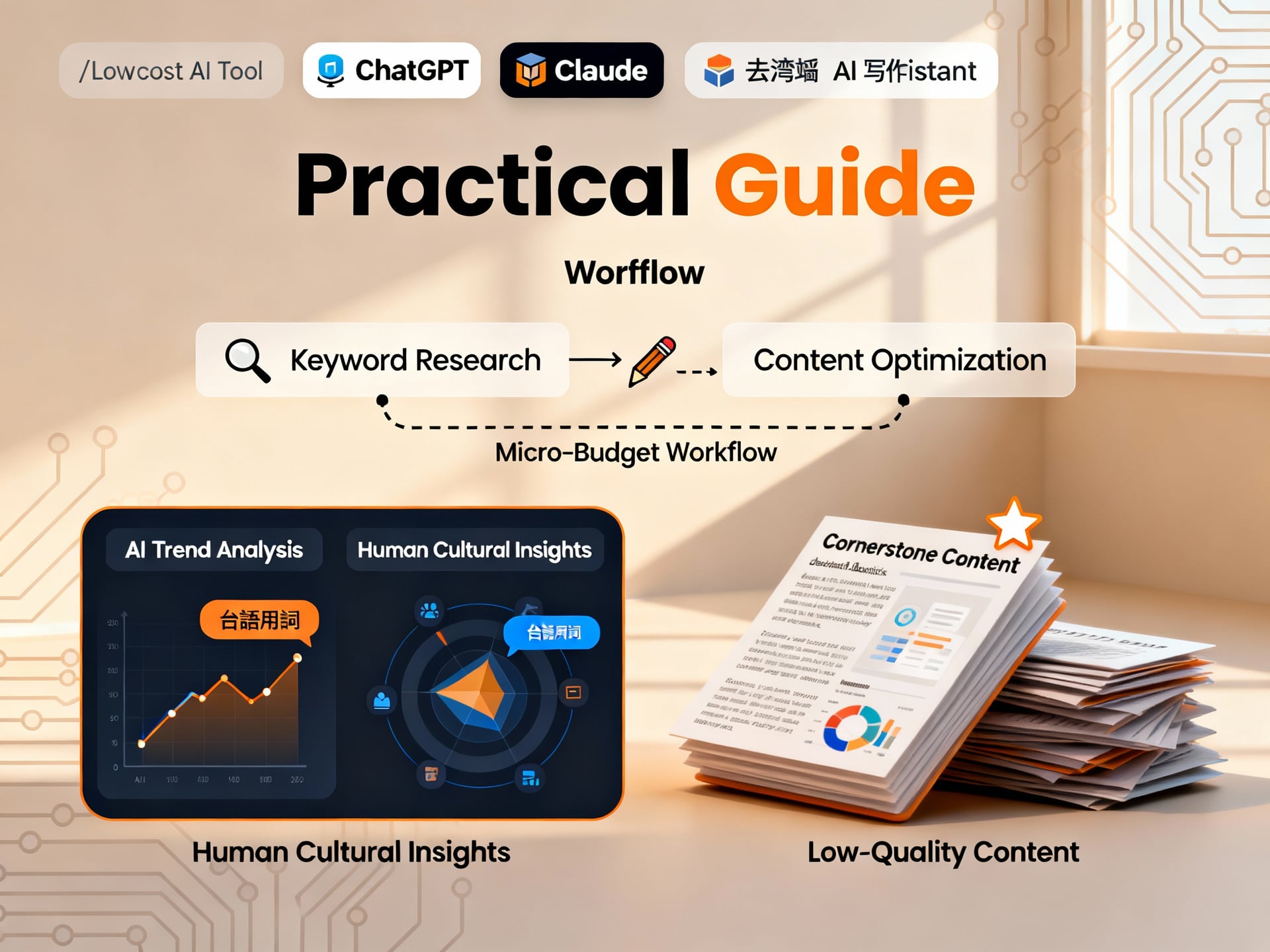
You don't need to purchase expensive enterprise-level tools. The free versions of ChatGPT, Claude, or AI writing assistants developed by Taiwanese teams can already meet most needs. The key is to establish a smooth "human-machine collaboration" workflow:
- AI Keyword Research: Instruct the AI to analyze the "colloquial long-tail keywords" used by Taiwanese netizens when discussing your industry on platforms like Mobile01 and Dcard.
- AI Outline Generation: Provide local Taiwanese case studies or data, and ask the AI to generate an article outline that aligns with Chinese reading logic.
- Human Content Creation: Based on the outline, fill it with your unique experiences, customer stories, and photos of actual products you've taken.
- AI Optimization and Rewriting: Take the content written by humans and ask the AI to check grammar, generate introductions in different styles, or rewrite it into a shorter version suitable for Facebook posts.
AI-Assisted Research for Localized Keywords and Long-Tail Phrases
AI can quickly scan large amounts of data, but interpreting "local nuances" still requires a human touch. For example, AI might identify the broad term "waterproofing engineering," but you, familiar with the Taiwanese market, know that "old apartment rooftop waterproofing" or "exterior wall seepage treatment during Kaohsiung's rainy season" are the long-tail phrases that truly drive conversions. Use AI to find possibilities, then let you, the "Taiwan expert," do the screening and validation.
Budget Allocation: The Trade-off Between Content Quality and Publishing Frequency
I recommend adopting a "Cornerstone Content + AI Amplification" model. Allocate 70% of your content creation budget to producing 3-5 extremely detailed cornerstone articles that solve core problems (e.g., "Starting a Tainan Snack Shop: A Complete Guide from Licenses and Equipment to Marketing"). Use the remaining 30% of the budget to repurpose these cornerstone pieces with AI into FAQs, social media posts, and short video scripts to maintain daily publishing frequency. This approach builds authority while keeping your presence active.
Specific Budget Execution Checklist (Monthly Budget Example):
- NT$5,000 Level: Focus on 1 piece of in-depth cornerstone content (self-written or outsourced) + AI-assisted adaptation into 10 social media posts.
- NT$15,000 Level: Produce 2 pieces of cornerstone content + Hire a part-time community manager for localization polishing and community interaction + AI-assisted keyword research.
- NT$30,000 Level: Produce 3 pieces of cornerstone content + Use basic paid SEO tools (like Ahrefs or similar) for competitive analysis + Systematically execute the Social SEO strategy mentioned below.
Practical Implementation Details of Social SEO in Taiwan
Whether social signals directly impact rankings has long been a topic of debate in the SEO community. One side argues that social shares and likes are external behaviors and not a direct ranking factor for Google. The other side firmly believes that content with high engagement drives genuine traffic, natural backlinks, and brand searches—all of which are indirect authority signals highly valued by search engines.
My Analysis: Rather than debating whether it's a "direct ranking factor," it's more practical to view it this way: In Taiwan, social platforms serve as a "stress test" and "amplifier" for content. An article that sparks discussion on Dcard or gets widely shared on LINE inherently possesses high topicality and value. These metrics strongly align with the E-E-A-T (Experience, Expertise, Authoritativeness, Trustworthiness) that Google prioritizes. Therefore, the essence of Social SEO is to validate and amplify your content's influence through social channels.
How Social Signals Affect Local Search Rankings
The search journey for Taiwanese users is often cross-platform. They might search "Changhua camping recommendations" on Google, read your article, then search for related hashtags and real photos on Instagram, and finally check user reviews on the Outdoor board of PTT. Throughout this process, your brand's presence and the quality of interactions across these major platforms collectively shape a comprehensive impression of "local authority." Search engines track these cross-platform data points to assess a brand's genuine influence.
Optimization Techniques for Interactivity in AI-Generated Social Content
When using AI to generate social media posts, the biggest pitfall is producing robotic promotional copy. You must instruct the AI to incorporate "engagement hooks." For example:
- Avoid writing: "We have launched a new waterproof coating service."
- Instead, instruct the AI to write: "Hey folks in Kaohsiung! With all the afternoon thunderstorms lately, have you started seeing 'maps' forming on your walls? We've handled moisture damage issues in many old houses in Fengshan and found that 80% of leaks start from this spot... (includes image) Is your home experiencing something similar? Snap a pic in the comments and we'll take a look for you!"
The latter version integrates local relevance, shared problem recognition, professional demonstration, and a clear call to action—this is the kind of content that resonates and elicits responses from Taiwanese netizens.
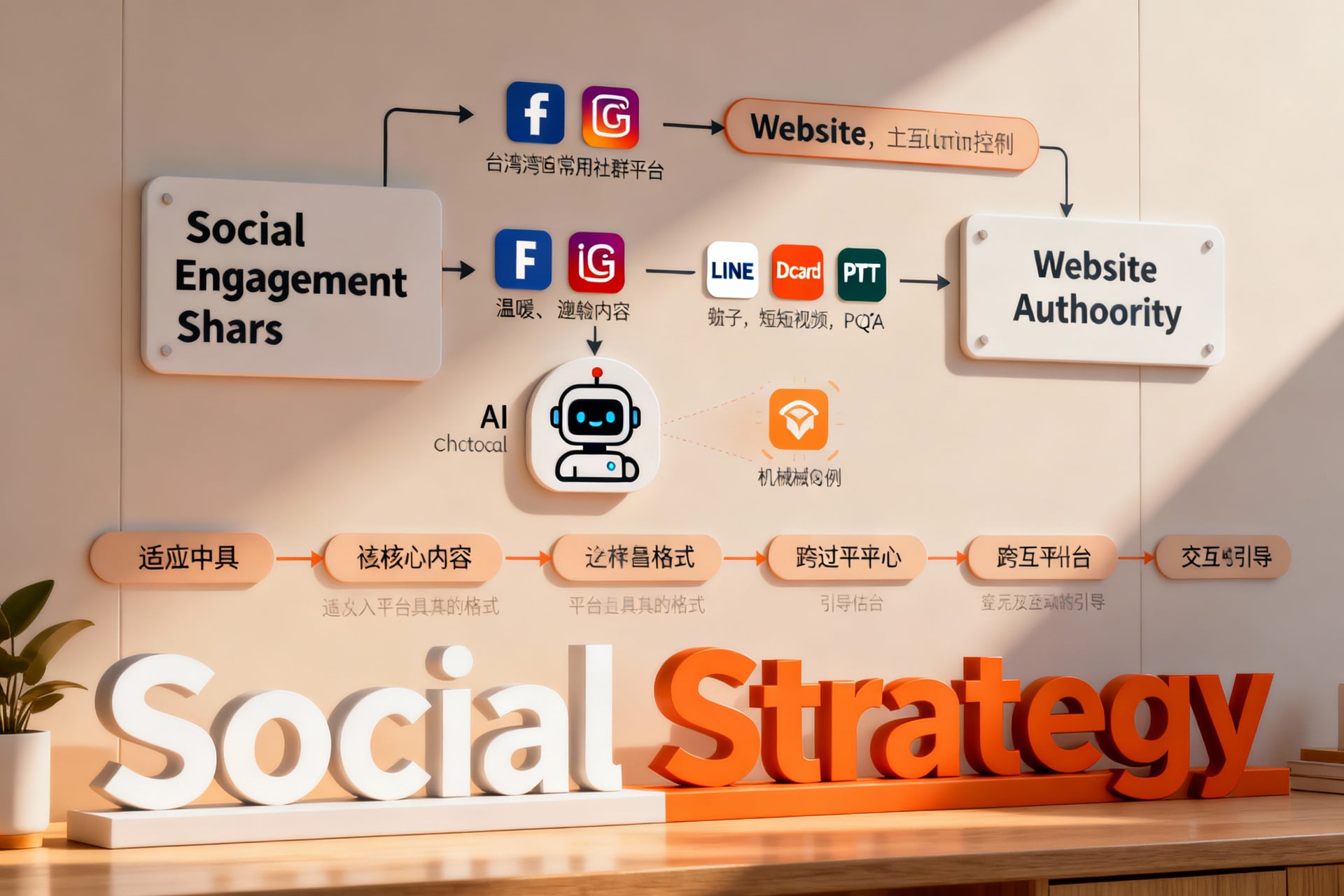
Integrated Content Distribution Strategy for LINE, Dcard, and PTT
Different platforms require different strategies:
- LINE Official Account: Crucial for "local search." Ensure your business information is complete. Use AI to adapt key points from your blog into "knowledge nuggets" within the account's graphic menu. This significantly increases the chance your account appears when users search for related services within LINE.
- Dcard & PTT: Direct advertising is a major taboo here. Transform your cornerstone content into "experience sharing" or "problem discussion" posts. For example, adapt a "renovation experience" article into a post titled "Long read ahead! My complete record of outsmarting a Taipei old house renovation contractor" and share it on relevant boards. AI can help you reformat long-form content into a forum-friendly style with engaging hooks.
- Facebook/Instagram: Use AI to generate short video scripts. Turn complex service processes (like waterproofing steps) into 15-second comparison videos, emphasizing your local service areas (e.g., "We primarily serve Zhongli and Pingzhen Districts in Taoyuan").
Concrete Actionable Advice: Establish a "Content Hub - Satellite Distribution" model. Use your website's cornerstone content as the central hub. Then, leverage AI to quickly generate different versions of assets suitable for LINE (knowledge cards), Dcard (experience-sharing posts), and FB (short video scripts). Implement a planned cross-platform publishing schedule with guided interaction.
Conclusion
Generative AI is undoubtedly a game-changer in the SEO field, but it is not a magic wand that turns everything to gold. Rather, it is a powerful tool that must be guided by "white-hat ethics" and "localized wisdom." The true path to success lies in deeply integrating AI's "efficiency and scale" with human "professional judgment."
For resource-limited small and medium-sized enterprises (SMEs) in Taiwan, this is actually an advantageous starting point. From the outset, we cannot compete in the race to produce massive amounts of low-quality content. Instead, we are compelled to think about how to use our most precise resources to create maximum value. By establishing clear ethical boundaries, focusing micro-budgets on cornerstone content, and leveraging Taiwan's unique social media ecosystem for content validation and amplification, we can not only avoid search engine penalties but also build a brand's genuine, enduring authority.
Now, please re-examine your AI-assisted content workflow: Does every article, every post pass the "value self-assessment"? Is it infused with the localized Taiwanese insights that only you can provide? Starting today, launch your sustainable SEO strategy of "AI for efficiency, human for oversight." On the path of compliance, steadily win the search rankings that belong to you.
Further Reading
相關文章

Review SEO Case Study Analysis: Complete Guide to Ranking Improvement for Taiwanese Websites

How to Turn Keyword Rankings into Actual Conversions? Taiwan SEO Practical Strategy Analysis

Practical Strategies to Improve Website Ranking: 3 Key Steps and Success Stories
